Overview
The U.S. has rapidly entered a new phase of international engagement on critical mineral supply chains. Since late 2025, the administration has finalized a range of nonbinding frameworks—including bilateral agreements, memoranda of understanding, action plans, strategic partnerships, and plurilateral initiatives. These arrangements serve as testing grounds for the administration’s critical minerals trade strategy and may lay the foundation for future international negotiations.
The Climate Leadership Council has been at the forefront of shaping a comprehensive international approach to supply chain security. So far, we have provided recommendations to the Office of the United States Trade Representative (USTR) on how to leverage existing agreements, such as the United States-Mexico-Canada Agreement (USMCA) and the African Growth and Opportunity Act (AGOA), and on the design of emerging agreementsi like the Plurilateral Agreement on Trade in Critical Minerals.
This reference guide surveys the current landscape of critical minerals agreements, highlighting representative examples, cataloging their primary objectives and policy tools, and assessing their alignment with the Council’s recommendations.
The frameworks covered in this guide are: Critical Mineral Frameworks, Memorandums of Understanding (MOU), Action Plans, Strategic Partnerships, Pax Silica, the Quad Framework, and the Forum on Resource Geostrategic Engagement (FORGE)
Recommendations:
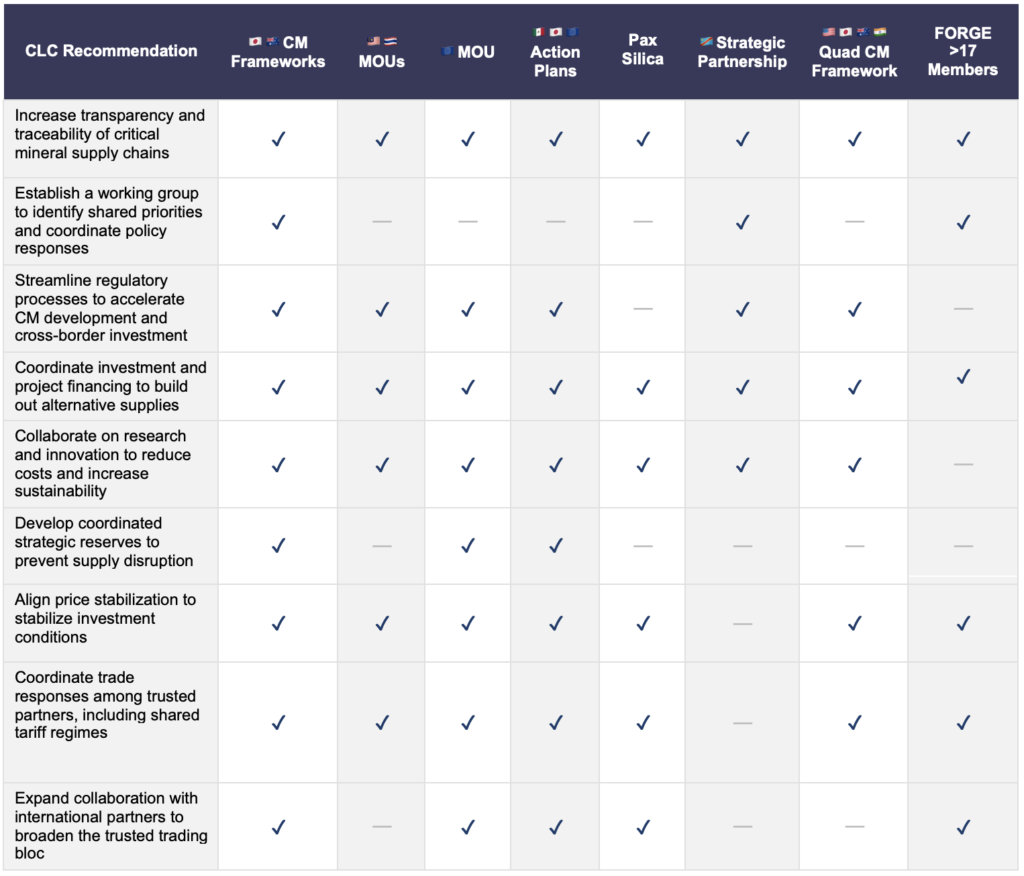
The recommendations below form the analytical framework used to assess each agreement.
- Increase transparency and traceability of critical mineral (CM) supply chains
- Establish a working group to identify shared priorities and coordinate policy responses
- Streamline regulatory processes to accelerate CM development and cross-border investment
- Coordinate investment and project financing to build out alternative supplies
- Collaborate on research and innovation to reduce costs and increase sustainability
- Develop coordinated strategic reserves to prevent supply disruption
- Align price stabilization mechanisms to enhance investment conditions
- Coordinate trade responses among trusted partners, including shared tariff regimes
- Expand collaboration with international partners to broaden the trusted trading bloc
Recommendation Alignment at a Glance:
The table below assesses how the administration’s nonbinding agreements comport with the Council’s nine policy recommendations for effective critical mineral trade partnerships. A check mark (✓) indicates a relevant provision exists; a dash (—) indicates no relevant provision.
Flag Key
🇯🇵 Japan 🇹🇭 Thailand
🇦🇺 Australia 🇪🇺 European Union
🇲🇾 Malaysia 🇲🇽 Mexico
🇨🇩 DRC 🇮🇳 India
🇺🇸 U.S.
Agreement Profiles:
The following profiles detail examples of each type of agreement, including its partners, status, stated objectives, primary policy tools, and notable provisions as they relate to the Council’s supply chain security recommendations.
| Date | October–November 2025 |
| Objective | Strengthen critical mineral and rare earth supply chain security; accelerate investment and reduce concentration risk. |
| Key Tools | Coordinated financing and investment support; project identification; permitting reform; price-support mechanisms and standards-based markets; stockpiling; investment screening and asset-sale review. |
| Notable Provisions | • Transparency & Traceability: Review and deter critical mineral asset sales on national security grounds • Working Group: Convene a Mining, Minerals & Metals Investment Ministerial and establish a Rapid Response/Supply Security Response Group • Streamline Regulation: Accelerate and streamline permitting timelines • Investment & Financing: Mobilize public and private support through grants, guarantees, loans, equity, insurance, regulatory facilitation, and offtake arrangements; commit financing support within six months; jointly identify priority projects • Strategic Reserves: Leverage strategic stockpiles and explore complementary stockpiling arrangements • Price Stabilization: Develop high-standard marketplaces and pricing mechanisms, including price floors or similar measures • Trade Coordination: Address non-market policies and unfair trade practices |
MOUs on Cooperation to Diversify Global Critical Mineral Supply Chains & Promote Investment
| Date | 2025–2026 |
| Objective | Diversify global critical mineral supply chains; promote trade and investment; reduce domestic vulnerabilities arising from third country non-market practices and policies. |
| Key Tools | Information sharing; investment coordination and prioritization; regulatory cooperation; permitting facilitation; standards-based market development; cooperation on investment screening and asset-sale reviews. |
| Notable Provisions | • Transparency & Traceability: Increase information exchange on project bids, investment opportunities, and supply chain developments; Strengthen cooperation on investment screenings and asset-sale reviews • Streamline Regulation: Cooperate on good regulatory practices, permitting streamlining, and fair treatment of cross-border investors • Investment & Financing: Grant U.S. investors first-opportunity rights in critical mineral asset sales; promote investment and trade between participants • Price Stabilization: Explore standards-based marketplaces and price floors or similar measures • Trade Coordination: Coordinate trade measures supporting a resilient marketplace |
MOU on a Strategic Partnership on Critical Minerals
European Union[v]
| Date | March 2026 |
| Objective | Develop secure, sustainable critical mineral supply chains across the full value chain, including supply- and demand-side measures. |
| Key Tools | Information sharing; investment coordination and financing; regulatory cooperation; stockpiling; research and innovation collaboration; demand-side coordination. |
| Notable Provisions | • Transparency & Traceability: Increase information exchange on critical mineral supply chains; coordinate risk assessments, analytical tools, and responses to third-country supply disruptions and export controls; Promote responsible business conduct and sustainability standards across supply chains • Streamline Regulation: Streamline permitting and cooperate on regulatory standards for mining, processing, and recycling • Investment & Financing: Improve visibility of investment opportunities; prioritize and facilitate financing and de-risking support for strategic projects; Coordinate financial support and other de-risking instruments for strategic projects • Research & Innovation: Collaborate on geological mapping, earth observation, extraction technologies, and innovation • Strategic Reserves: Cooperate on stockpiling and supply security measures • Trusted Trading Bloc: Explore broader plurilateral cooperation on critical minerals, including complementarity with Forum on Resource Geostrategic Engagement (FORGE) and related initiatives |
Critical Minerals Action Plans
Mexico;[vi] Japan;[vii] EU[viii]
| Date | February–April 2026 |
| Objective | Stabilize markets; lay the foundation for a binding plurilateral critical mineral trade agreement with border-adjusted price floors and other trade protections. |
| Key Tools | Explore and develop border-adjusted price floors and a standards-based market; coordinate trade policies and price gap subsidies. |
| Notable Provisions | • Transparency & Traceability: Cooperate on investment screenings • Streamline Regulation: Develop regulatory standards for mining, processing, and trade; Consult on regulatory standards • Research & Innovation: Advance technical cooperation • Investment & Financing: Improve visibility and undertake opportunities for joint investments; identify specific priority projects • Strategic Reserves: Cooperate on stockpiling • Price Stabilization: Consult on a standards-based marketplace and price support mechanisms; explore border-adjusted price floors (Japan) • Trade Coordination: Develop a preferential agreement with border-adjusted price floors and other trade protections; addresses economic coercion (Japan) • Trusted Trading Bloc: Serves as an explicit foundation for broader binding plurilateral agreement |
Pax Silica[ix]
As of June 2026: Australia, Argentina, Chile, Costa Rica, El Salvador, Finland, Germany, Greece, India, Israel, Japan, Kazakhstan, the Netherlands, Norway, Panama, the Philippines, Qatar, the Republic of Korea, Singapore, Sweden, the United Arab Emirates, and the United Kingdom.
| Date | December 12, 2025 |
| Objective | Secure the full AI-era technology supply chain among trusted partners. |
| Key Tools | Advance joint ventures, offtake coordination, protection of sensitive technologies, trusted ecosystem standards, and sovereign wealth fund commitments. |
| Notable Provisions | • Transparency & Traceability: Develop trusted technology standards across the full supply chain • Investment & Financing: Pursue joint ventures and strategic co-investment; publicly announced support includes $250 million through the State Department Pax Silica Fund and sovereign wealth fund commitments; establish economic security zones; Coordinate long-term offtake arrangements to protect private investment • Research & Innovation: Build innovation-led ecosystems • Trade Coordination: Coordinate responses to overcapacity and dumping • Trusted Trading Bloc: Expand membership; integrate observer nations |
DRC Strategic Partnership
Democratic Republic of Congo[x]
| Date | December 4, 2025 |
| Objective | Secure long-term U.S. preferential access to DRC’s critical minerals; reduce Chinese dominance in the DRC mining sector; develop DRC’s domestic processing and beneficiation capacity. |
| Key Tools | Establish a Strategic Asset Reserve and Joint Steering Committee; DRC commits to regulatory and tax reform; prioritization for International Development Finance Corporation (DFC) equity investment. |
| Notable Provisions | • Transparency & Traceability: Develop traceable supply chains; formalize and regulate artisanal mining; advance anti-corruption reforms • Working Group: Establish Joint Steering Committee to oversee implementation and investment frameworks • Streamline Regulation: DRC commits to amend mining laws; establish preferential tax incentives and 10-year stabilization for U.S. investors • Investment & Financing: Grant the U.S. and allied investors first-opportunity rights in critical mineral asset sales; prioritize DFC equity investment and public and private financing for exploration and processing • Research & Innovation: Collaborate on critical mineral surveying and mapping; build mineral processing capacity; technical support to help small-scale mining become formal and regulated |
Quad Critical Minerals Framework
U.S., Japan, Australia, India[xi]
| Date | May 2026 |
| Objective | Accelerate the development of diversified, fair critical mineral markets and strengthen the supply of minerals essential to the region’s economic growth and security. |
| Key Tools | Use economic policy tools and coordinate investment; align regulatory environments; cooperate on e-waste recovery and innovation. |
| Notable Provisions | • Transparency & Traceability: Strengthen investment screenings • Streamline Regulation: Share best practices and technical approaches for permitting, licensing, and regulatory processes • Investment & Financing: Mobilize up to $20 billion in public and private support, using public federal funding tools and new mechanisms to mobilize private capital • Research & Innovation: Cooperate to improve recovery and use of critical minerals from e-waste and other scrap materials; cooperate on geological mapping • Price Stabilization/Trade Coordination: Consider measures to address non-market policies and unfair trade practices, including high-standard marketplaces and price mechanisms |
Forum on Resource Geostrategic Engagement[xii](Formerly, Mineral Security Partnership [MSP])
Members: Australia, Canada, Estonia, Finland, France, Germany, India, Italy, Japan, Norway, the Republic of Korea, Sweden, the United Kingdom, the United States, and the European Union[xiii]
| Date | Launched: February 4, 2026; Principles Released: July 10, 2026 |
| Objective | To collaborate at the policy and project-level to advance initiatives that strengthen diversified, resilient, and secure critical mineral supply chains. |
| Key Tools | Working groups; consensus-based cooperation; engagement with DFIs, ECAs, MDBs, and private sector operators through the former MSP Finance Network. |
| Notable Provisions | • Transparency & Traceability: Support high standards in mining, processing, and recycling to strengthen supply chain transparency and market confidence. • Working Group: Establish a Policy Coordination Working Group & a Project Investment Working Group to meet regularly. • Investment & Financing: Projects Investment Working Group will coordinate strategic investment in extraction, processing, and recycling; maintain shared registry of priority projects for joint investment; de-risk high-impact projects with development finance institutions, export credit agencies, and private stakeholders. • Price Stabilization/Trade Coordination: Advance market-based principles and counter non-market distortions; coordinate measures to diversify supply chains. • Expand Trusted Trading Bloc: Leverage bilateral and multilateral agreements, strategic investments, and trade/investment policies to support projects globally |
[i] The White House, “United States–Japan Framework for Securing the Supply of Critical Minerals and Rare Earths Through Mining and Processing,” October 27, 2025, https://www.whitehouse.gov/briefings-statements/2025/10/united-states-japan-framework-for-securing-the-supply-of-critical-minerals-and-rare-earths-through-mining-and-processing.
[ii] The White House, “United States–Australia Framework for Securing of Supply in the Mining and Processing of Critical Minerals and Rare Earths,” October 20, 2025, https://www.whitehouse.gov/briefings-statements/2025/10/united-states-australia-framework-for-securing-of-supply-in-the-mining-and-processing-of-critical-minerals-and-rare-earths/.
[iii] The White House, “U.S.–Malaysia Critical Minerals MOU,” October 26, 2025, https://www.whitehouse.gov/briefings-statements/2025/10/memorandum-of-understanding-between-the-government-of-the-united-states-of-america-and-the-government-of-malaysia-concerning-cooperation-to-diversify-global-critical-minerals-supply-chains-and-promote.
[iv] The White House, “U.S.–Thailand Critical Minerals MOU,” October 2025, https://www.whitehouse.gov/briefings-statements/2025/10/memorandum-of-understanding-between-the-government-of-the-united-states-of-america-and-the-government-of-the-kingdom-of-thailand-concerning-cooperation-to-diversify-global-critical-minerals-supply-cha.
[v] European Commission. “EU and US Launch Strategic Partnership on Critical Minerals.” April 23, 2026, https://ec.europa.eu/commission/presscorner/detail/en/ip_26_862.
[vi] Office of the United States Trade Representative, “U.S.–Mexico Critical Minerals Action Plan,” February 4, 2026, https://ustr.gov/sites/default/files/files/Press/Releases/2026/FINAL%20Critical%20Minerals%20Action%20Plan_US%20MX%20for%20release%204%20Feb%202026.pdf.
[vii] Office of the United States Trade Representative, “U.S.–Japan Critical Minerals Action Plan,” March 19, 2026, https://ustr.gov/sites/default/files/files/Press/Releases/2026/U.S.-Japan%20Critical%20Minerals%20Action%20Plan%203.19.2026.pdf.
[viii] European Commission, “EU–US Strategic Partnership on Critical Minerals,” April 23, 2026, https://ec.europa.eu/commission/presscorner/detail/en/ip_26_862.
[ix] U.S. Department of State, “Pax Silica,” Accessed June 29, 2026, https://www.state.gov/pax-silica.
[x] U.S. Department of State, “Strategic Partnership Agreement Between the Government of the United States of America and the Government of the Democratic Republic of the Congo,” December 4, 2025, rica-and-the-government-of-the-democratic-republic-of-the-congo.
[xi] U.S. Department of State, “Quad Critical Minerals Initiative Framework Among the United States, Japan, Australia, and India,” May 2026, https://www.state.gov/releases/office-of-the-spokesperson/2026/05/quad-critical-minerals-initiative-framework-among-the-united-states-japan-australia-and-india.
[xii] Inside U.S. Trade, “U.S. Takes Over as FORGE Chair, Releases Coalition’s ‘Guiding Principles,’” July 14, 2026, https://insidetrade.com/critical-minerals-news/us-takes-over-forge-chair-releases-coalition-s-guiding-principles.
[xiii] Center for Strategic and International Studies, “Critical Minerals Ministerial Introduces New International Cooperation Strategy,” February 13, 2026, https://www.csis.org/analysis/critical-minerals-ministerial-introduces-new-international-cooperation-strategy.