
The Chinese Communist Party’s (CCP) state-directed industrial policies and market manipulation have concentrated control across key segments of the critical mineral value chain. This dominance results in a global market with significant systemic vulnerabilities that directly impact U.S. economic competitiveness, advanced energy deployment, and national security. Increasingly, the CCP has demonstrated a willingness to leverage this market position for geopolitical gain, underscoring the strategic risks to U.S. firms.
In response, U.S. policymakers have pursued a range of domestic and international initiatives to strengthen critical mineral supply chains, including federal investments in domestic capacity, public-private partnerships, and a range of international agreements encompassing critical mineral action plans with Mexico, Japan, and the European Union, as well as non-binding plurilateral initiatives, the Forum on Resource Geostrategic Engagement (FORGE), and Pax Silica. These international efforts may serve as a starting point for a plurilateral Agreement on Trade in Critical Minerals (ATCM), the broader preferential trade framework that the Office of the United States Trade Representative (USTR) is exploring.
To inform the design of an ATCM, and building on the Council’s previous comments to USTR, this analysis examines the global distribution of production and processing capacity across the critical mineral categories that are essential to advanced energy technologies like renewable energy, batteries, electricity infrastructure, and nuclear power. Production and processing trends can inform where trade, investment, and other policy tools can most effectively reduce supply chain vulnerabilities—essential context for the design of an ATCM.
Production and Processing Data:
Critical mineral supply chains begin upstream with the mining and extraction of raw materials. At this stage, production is generally distributed across a diverse set of countries endowed with commercially viable geologic resources. Global hotspots include Sub-Saharan Africa’s Copperbelt, South America’s Lithium Triangle, and allied producers such as Australia, Canada, and Mexico.
Mainland China does not have a significant geologic advantage; its resources and upstream capacity are concentrated in a narrow set of critical minerals, including rare earth elements (REE) and natural graphite. However, what China lacks in natural resources, it is pursuing through major investments in international mining projects. They have already amassed substantial control of manganese mining in South Africa and cobalt mining in the Democratic Republic of the Congo. The full extent of Chinese investment in—and control of—mining operations in third-party countries is not fully known.
Chart 1. Global Upstream Production for Critical Minerals Essential to Advanced Energy Technologies
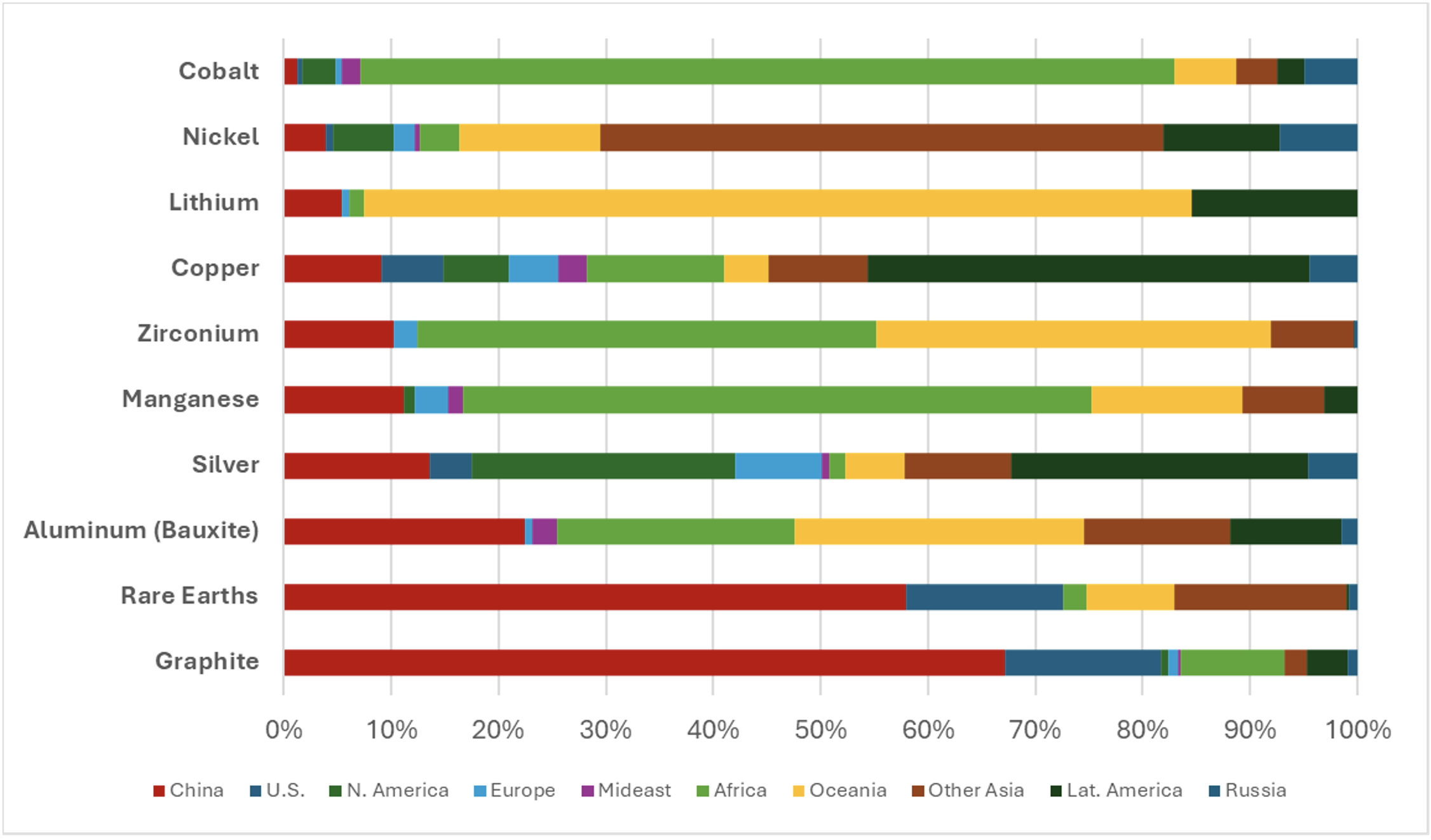
Source: USGS 2022 data; excludes minerals that are not mined: Tellurium (byproduct) and Silicon (processed material), and where USGS data is unavailable: uranium. The data does not reflect Chinese foreign investment in third-country mineral operations.
Midstream Processing—i.e., chemical processing, smelting, and refining—is the root of CCP critical mineral control. The CCP dominates the processing of most critical minerals, leveraging decades of state subsidies, non-market pricing, and vertically integrated state-owned enterprises to create conditions that are often uneconomic for foreign competitors. Across the critical minerals assessed, China holds more than half of global processing capacity in all but three. This concentration gives the CCP significant influence over the supply of inputs needed for a wide range of advanced energy technologies, from lithium-ion batteries to grid infrastructure.
Chart 2. Global Midstream Processing Capacity for Critical Minerals Essential to Advanced Energy Technologies
Source: USGS; Silverado Policy Accelerator. Data for certain minerals is withheld or unavailable. The data does not reflect Chinese foreign investment in third-country mineral operations.
China’s dominance in mineral processing allows it to exert outsized influence over global minerals markets, creating systemic vulnerabilities, even in minerals where it has limited domestic mining operations. As the primary buyers of unprocessed materials, Chinese firms can shape demand, influence mine operators, and affect material prices. At the same time, their control of processed minerals and component parts sales enables them to influence market conditions and prices further down the supply chain.
When mining and processing data are considered together, the CCP’s greatest market leverage stems from minerals where it has a substantial presence across the full value chain. China presently holds majority global shares over graphite and REEs; as the CCP’s international investment strategy takes shape, we may see them similarly consolidate control over both supply chain segments for additional minerals.
What does this mean for an ATCM?
An ATCM will be most successful if it can stunt the CCP’s ability to manipulate global price and supply in ways that can cripple U.S. industries. The U.S. and its partners need clear data to identify the most concentrated and strategically vulnerable segments in mineral-specific supply chains so they can tailor appropriate interventions and allocate resources effectively.