
Increasing electricity demand for data centers is grabbing headlines, driving concerns over reliability and affordability while generating backlash from policymakers and the public. Step back for more context, though, and it’s clear AI is only part of the story.
Gigantic investments in data centers are just one driver of increased electricity demand, called “load growth.” Population and economic growth, industrial electrification, expansion of the U.S. electric vehicle (“EV”) fleet, and data centers are all bringing new forms of load to the electricity system after 15 years of relatively flat demand. Figure 1 identifies the four largest drivers of future load growth and the potential scale of each component.
Figure 1 – Projected U.S. electricity demand (2022 to 2050) by customer type (terawatt-hours)
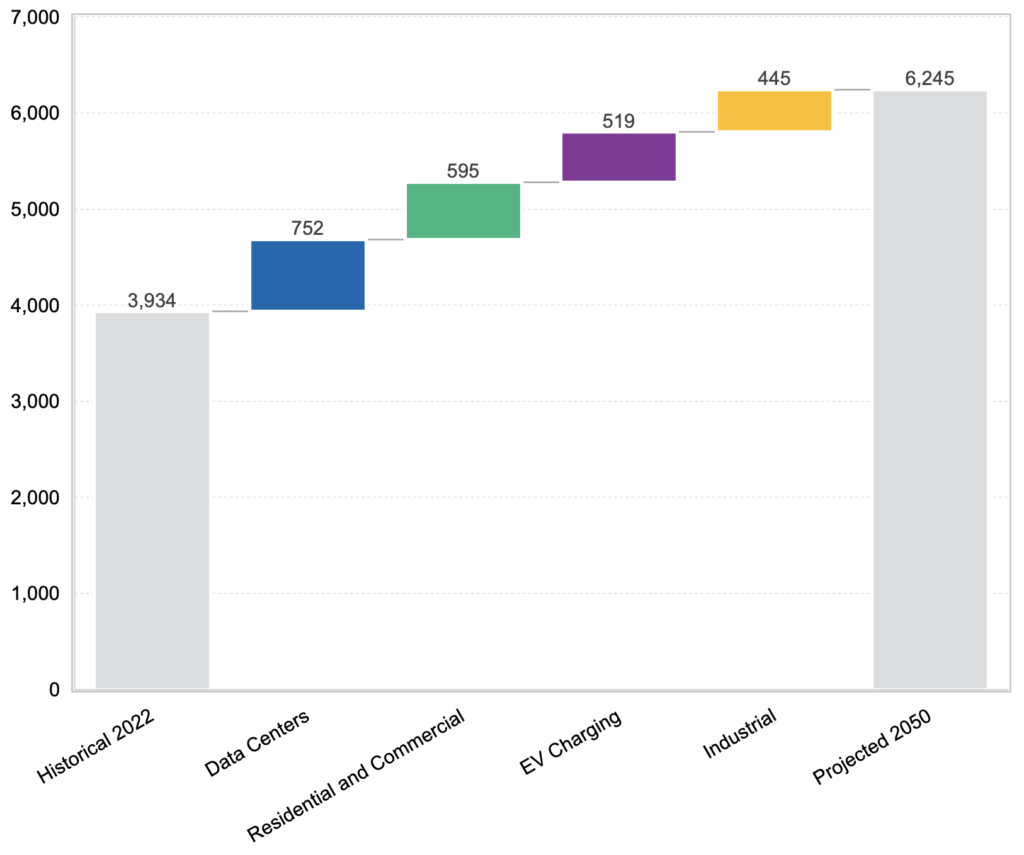
Using data from the Council’s energy sector model, CERT, we identify that load will increase 59% above 2022 levels (the last year before the data center “boom”) by midcentury—but most projected demand will come from sources other than data centers.
- Data center expansion accounts for 752 terawatt-hours (“TWh”) of load growth through 2050.
- Population, income, and economic growth are projected to increase residential and commercial electricity demand by 595 TWh.
- If EV adoption rates remain consistent with estimates, there will be roughly 97 million EVs on U.S. roads by 2050 that will require 519 TWh of charging.
- New technology adoption and advanced manufacturing will increase industrial demand by 445 TWh.
The precise timing and magnitude of this growth in electricity demand remain uncertain, but the underlying drivers—economic expansion, industrial electrification, transportation electrification, and digital infrastructure—are durable trends. Policy changes would also influence load growth. These estimates are based on a “business as usual” scenario, but shifts in the policy landscape can reshape electricity demand or cause it to grow even more rapidly.
The challenges presented by the scale of anticipated load growth are not without precedent. From 1960 to 2007, U.S. power generation grew 72 TWh per year (3.7% annually). The “business as usual” scenario outlined in Figure 1 requires U.S. power generation to grow at approximately half that annual rate (or 1.8% annually).
Said differently: Even without the data centers, we were always going to confront rising electricity demand and the need to modernize our grid if we want economic growth, modern manufacturing, and lower emissions.
Today’s load growth makes the challenge more acute. It also brings the political will to build a larger, cleaner, and more dynamic electricity system that delivers secure, reliable, and affordable power.
We can do this. We’ve done it before.
SUMMARY OF DATA SOURCES
- Residential, Commercial, and Industrial – U.S. Energy Information Administration based on projected population, income, and GDP growth rates
- Data Centers – U.S. Department of Energy historical data and projections out to 2028 and trended to 2050 with a technology adoption curve reflecting data center saturation and long-term growth consistent with economic growth
- Electric Vehicles – consistent with Bloomberg New Energy Finance with vehicle characteristics (e.g., vehicle miles traveled, kilowatt-hours of power required per mile, etc.) based on U.S. Energy Information Administration data