As of September 28, 2026. No agreement text has been released; details are subject to change.
OVERVIEW
The Agreement on Trade in Critical Minerals (ATCM) is a proposed, binding plurilateral agreement led by USTR to build market-based critical mineral supply chains among like-minded trading partners. It follows a January 14, 2026, Section 232 proclamation on processed critical minerals. The proclamation directed USTR and the Department of Commerce to negotiate agreements with trading partners to reduce the national security risks of U.S. dependence on imported critical minerals.
In March 2026, USTR requested public comment on the agreement’s design, including pricing mechanisms, common standards, investment rules, enforcement, and coordination during market disruptions. The notice drew nearly 2,500 comments, including the Council’s design recommendations. Ambassador Greer has indicated that USTR expects to release a draft this year; no text has been made public.
Relevance to Congress: A binding trade agreement will require congressional action to implement. USTR can negotiate under delegated Section 232 authority, but Congress would need to approve any implementing legislation. Jurisdiction sits with Senate Finance and House Ways and Means.
RECENT DEVELOPMENTS
June: Reuters reported that USTR aimed to present binding bilateral proposals to Japan and the EU by the end of June and that an initial agreement could cover 5-10 minerals. No such proposals have been made public, and USTR has not confirmed the reported timeline or mineral scope.
August: USTR’s press release, its most recent public description of the agreement, points to:
- Partners: Japan, Mexico, and the EU, building on their action plans, with G7 finance and trade ministers also engaged.
- Scope: No official list. However, Greer mentioned that S&P Global’s draft cost benchmarks for gallium, germanium, tungsten, antimony, and NdPr will inform negotiations.
- Mechanisms: Phased-in, mineral-specific price floors, adjusted at the border, and common standards across partners.
BUILDING BLOCKS: ACTION PLANS AND G7
USTR has said ATCM negotiations will build on earlier U.S. engagement with G7 Finance and Trade Ministers and existing critical minerals action plans.
- Action plans (Mexico, Feb. 4; Japan, Mar. 19; EU, Apr. 24): The three action plans share a broadly similar framework, each laying the groundwork for a binding plurilateral agreement (including work on price floors, common standards, investment, and supply chain coordination). They differ at the margins: Japan adds coordination against economic coercion, and the EU goes further on market-stabilization tools, including price-gap subsidies and offtake agreements.
- G7 Trade Ministers (May 5–6): Endorsed plurilateral agreements as a potential path to commercially viable diversified supply and identified tools including joint procurement, quotas, price floors, and transparency and traceability mechanisms.
The figure below maps these actions with the mechanisms identified in USTR’s Federal Register notice to understand the potential scope and design of the ACTM, including where there is overlap.
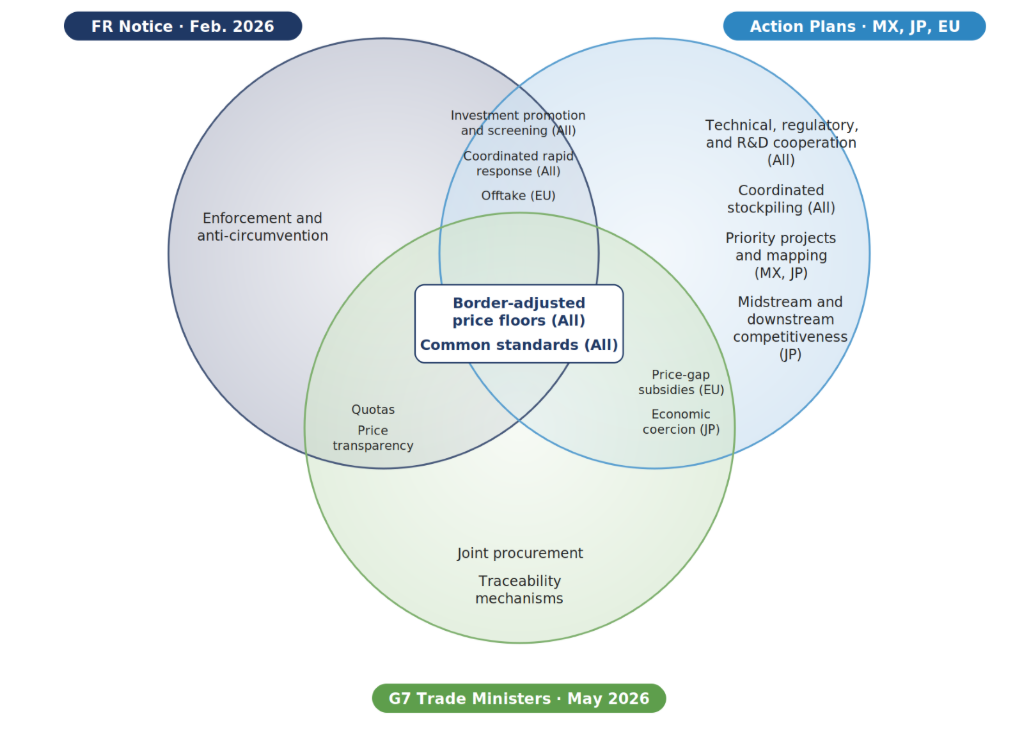
Sources: USTR Federal Register notice (Feb. 26, 2026), USTR action plan texts, G7 Trade Ministers’ Communiqué (May 7, 2026); The relevant tools of the action plans identify which country they apply to.
WHAT TO WATCH
The proposed design remains subject to change, with more granular details in areas, including:
- Structure and membership: Whether agreements will begin bilaterally before becoming plurilateral, who can join, and which commitments will be binding.
- Scope: Which minerals and stages of the supply chain will be covered.
- Mechanisms: How proposed tools, including price floors, will operate and whether they will include domestic requirements.
- Membership benefits: What trade, financing, procurement, or other benefits participation will provide.