
Critical mineral production and processing data reveal a consistent pattern: while mining and extraction are geographically dispersed, processing remains highly concentrated in one country—China. Across the critical minerals most relevant to advanced energy technologies, China holds the majority of global processing capacity in all but three.
This position gives the Chinese Communist Party (CCP) substantial leverage over critical mineral markets and the downstream industries that depend on them. Understanding this leverage is essential to designing effective policy responses and identifying where partnerships can have the greatest impact. As the Office of the U.S. Trade Representative (USTR) explores a plurilateral Agreement on Trade in Critical Minerals (ATCM), this analysis identifies U.S. exposure to two mechanisms by which the CCP disrupts minerals markets.
Supply Disruption:
The CCP can interfere with access to critical minerals, processed materials, or intermediate products by restricting exports to foreign markets. To assess U.S. vulnerability to physical supply disruptions, we examine trade data for the critical mineral categories most essential to advanced energy technologies to identifying where exposure is greatest.
Trade can expose U.S. firms to supply disruption through two primary channels: direct and indirect.
Direct trade exposure occurs when U.S. firms import goods directly from Chinese suppliers. This trade relationship makes firms vulnerable to Chinese export control actions, including licensing requirements and Entity List designations. Rare earth elements (REE) and natural graphite have the greatest risk of disruption because the U.S. imports almost half to three-quarters, respectively, directly from Chinese suppliers. Moreover, China dominates the mining and processing of these minerals, giving U.S. firms few alternatives to CCP-linked supply.
Chart 1: U.S. Supply for Critical Minerals Essential to Advanced Energy Technologies
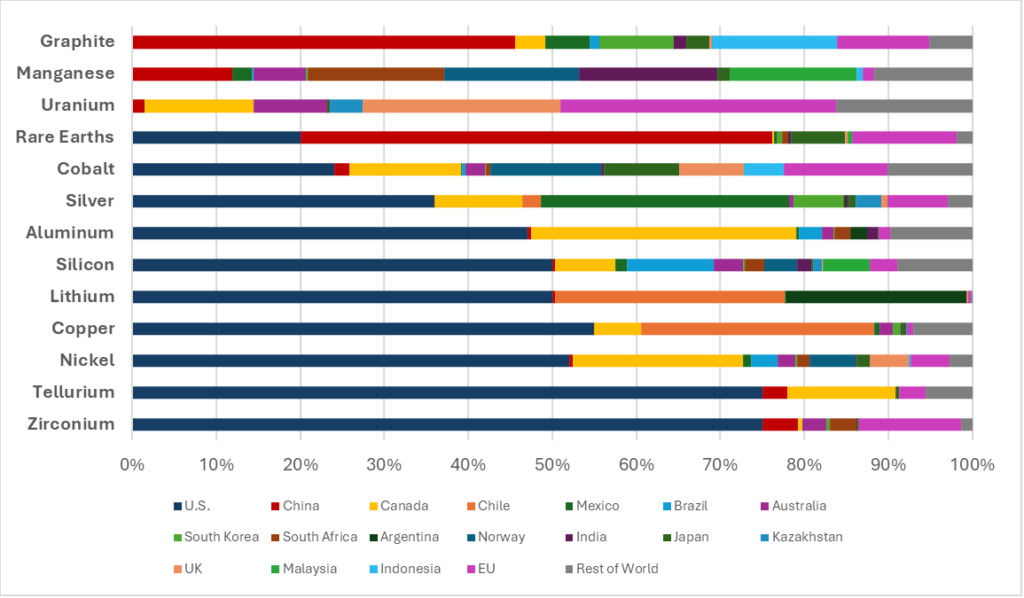
Sources: USGS; Selected Tariff Codes sourced from USGS Appendices for “Methodology and Technical Input for the 2025 U.S. List of Critical Minerals—Assessing the Potential Effects of Mineral Commodity Supply Chain Disruptions on the U.S. Economy”; Global Trade Tracker for trade data.
Since 2023, China has progressively tightened export controls—first restricting graphite, then imposing licensing requirements on seven medium and heavy rare earth elements in April 2025, before extending controls in October 2025 to additional products across the rare earth value chain. Although implementation of the October measures has been suspended until November 2026, the export control framework remains in place, and trade flows have yet to fully recover.
Most recently, on June 22, 2026, China added MP Materials and USA Rare Earth to its export control list, restricting their access to certain items that could have military uses, including certain rare earth materials, processing technologies, and specialized equipment. By targeting two companies central to U.S. rare earth supply chains, the CCP used export controls and related trade measures directly against firms critical to U.S. economic, energy, and national security interests.
Indirect trade exposure occurs when U.S. firms import from trading partners that source inputs from China. In these cases, disruptions to Chinese exports can affect U.S. manufacturers even when their immediate suppliers are located outside China.
This risk is particularly acute in critical mineral markets where China holds substantial control over the midstream stages. For example, though manganese is mined across South Africa, Gabon, and Australia, China accounts for roughly 90% of global manganese sulfate production — a key input for lithium-ion batteries. Although the U.S. imports just 13% from China and considerable shares from diverse countries like Norway, India, and Malaysia, the scale of Chinese market share leaves downstream U.S. firms vulnerable to CCP policy changes.
Through the currently suspended October 2025 export controls, the CCP sought to extend the reach of its export control regime beyond direct trade flows to foreign-made products incorporating Chinese rare earths or technology, regardless of where final assembly occurs. This means foreign exporters would need a license from the Chinese government to export covered products to third countries even when no Chinese entity is party to the transaction. If the suspension expires as scheduled, the measures would significantly expand the CCP’s reach over indirect trade and could place an estimated $6.5 trillion in annual downstream production across the automotive, defense, energy, and high-tech sectors at risk, with significant implications for U.S. manufacturing.
Taken together, these dynamics suggest that an effective ATCM must address both direct and indirect sources of supply disruption—reducing reliance on Chinese exports while ensuring that partner-country supply chains are also insulated from Chinese inputs and technologies.
Market Disruption:
The sheer scale of China’s position across multiple stages of the critical mineral value chain, most significantly midstream processing, creates a second category of vulnerability for the U.S. and partner countries—market disruption. Beyond export restrictions or other manipulations of physical trade flows, the CCP can use its market size to influence prices, manipulate investment incentives, and crowd out competitors to reinforce existing dependencies.
Recent market developments illustrate this dynamic.
- In 2023, rapid expansion of Chinese-influenced mining and processing capacity drove sharp price declines across lithium, cobalt, nickel, and graphite markets, with some commodity prices falling by as much as 60%. The resulting collapse in cobalt prices contributed to the closure of the U.S.’s only operating cobalt mine, despite $15 million in Department of Defense funding to support continued development of the project.
- In late 2024, Chinese overcapacity in battery-grade graphite prompted U.S. producers to petition the Department of Commerce for countervailing duties of up to 920%, alleging that unfair trade practices had undermined domestic production. Commerce’s preliminary investigation assigned countervailing duty rates as high as 721% to individual producers.
- In 2026, Chinese overcapacity in copper smelting drove benchmark treatment charges to $0 per ton for the first time on record, underscoring how excess processing capacity can erode project economics and leave smelters increasingly dependent on byproduct sales for revenue.
While lower prices may benefit downstream manufacturers in the short term, prolonged price suppression deters investment in alternative supply and locks in long-term dependence on CCP-controlled supply chains.
What does this mean for an ATCM?
To effectively counter CCP supply and market disruption, the U.S. needs partners with the resources and capacity to address supply vulnerabilities, and the market scale and collective leverage to counter market distortions. This context should inform how the U.S. constructs an ATCM and targets priority partners.