
The U.S. power grid is under strain and needs capacity to meet peak load, maintain reliability, and support affordability. According to the U.S. Department of Energy, “by 2030, the U.S. will need to add enough new resources to serve approximately 200 GW of peak demand.” Recent analysis has suggested there are large quantities of technically achievable grid capacity that could be brought online quickly to help address these challenges.
Figure 1 aggregates data from the U.S. Department of Energy (DOE) and trade associations and finds over 500 gigawatts (GW) of unrealized grid capacity.
Figure 1 – Additional technically feasible grid capacity by category (GW)
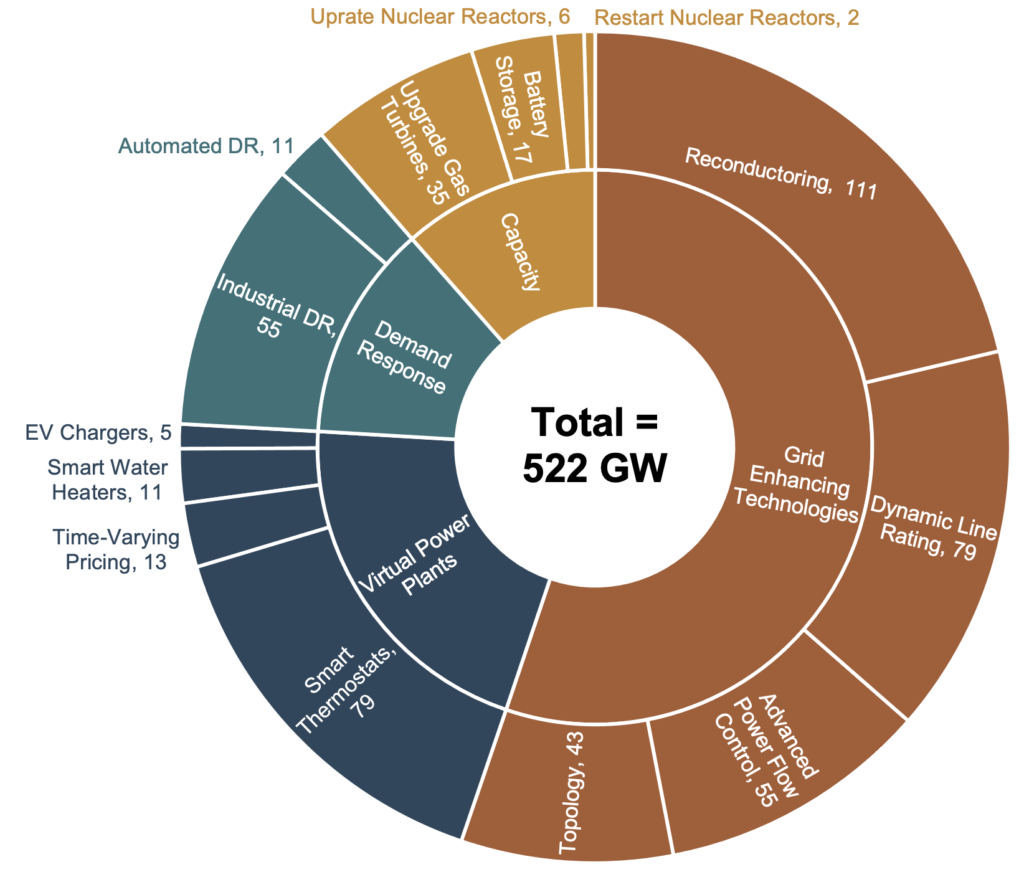
Note: Topology = Topology Optimization; EV = Electric Vehicle; DR = Demand Response
The potential capacity falls into several categories. The largest category is grid enhancing technologies (GETs) like reconductoring and dynamic line rating. The next largest categories are virtual power plants (PPs) and demand response (DR), followed by adding more capacity to existing power plants. The overall amount is 522 GW.
These categories should not be interpreted as 100% fully additive since some resources overlap geographically or operationally in the system. Nevertheless, they illustrate the large scale of technically feasible capacity that remains underutilized.
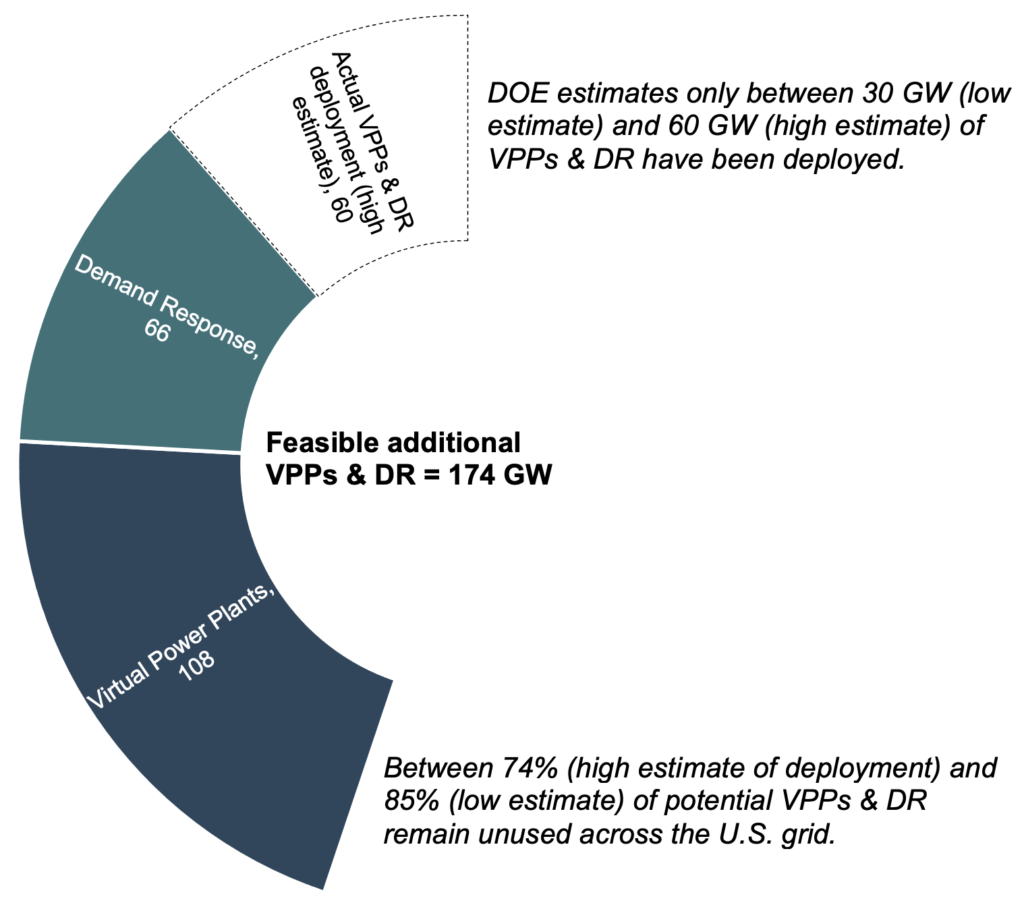
The scale of the technically feasible capacity is staggering and dwarfs the near-term needs of the U.S. electricity system. Take VPPs and DR as an example. According to DOE, only 30-60 GW of VPPs/DR is currently operating—or one-third the potential. Figure 2 shows the scale of the high estimate (60 GW) compared to 174 GW of potential.
Figure 2 – Deployed VPP and DR grid capacity compared to total feasible grid capacity (GW)
Many factors contribute to the underutilization of these low-cost, fast-deploying resources:
- Regulatory processes and planning have not always incentivized or allowed the sort of “non-wires alternatives” summarized in Figure 1. Some states (such as New York) have started integrating non-wires alternatives into planning.
- Utility regulations allow investor-owned utilities to earn a fixed rate of return on large capital assets (e.g., power plants, grid infrastructure). As a result, utilities often struggle to justify investments that require relatively diminutive capital spending, even when those investments improve utilization of existing assets and ultimately reduce operating costs. These misaligned incentives reduce deployment of these resources.
- The economics of these new investments are only now improving. Electricity demand in the U.S. was largely flat for 15 years, which contained costs and obscured the case for investments in grid capacity. Now electricity demand is increasing rapidly, and individual project economics may shift quickly.
Policymakers have been hotly debating the potential solutions to facilitate the large-scale buildout a modernized and more dynamic U.S. energy system will require. Addressing the challenges of siting, permitting, and interconnection to build new generation will be indispensable to future U.S. industrial and economic success.
But building new generation is only part of the answer. Policymakers must also prioritize fixes that unlock a considerable share of the grid’s technically feasible capacity today—fast, low-cost measures that buy time for new capital assets (e.g., power plants, transmission lines) to come online. These resources have enormous potential to meet growing electricity demand quickly and at relatively low cost compared to the alternatives. The Council just launched a new initiative to help policymakers deploy resources today, plan for tomorrow, and build a modern electricity system.
SUMMARY OF DATA SOURCES
- Grid Enhancing Technologies – Pathways to Commercial Liftoff: Innovative Grid Deployment, U.S. Department of Energy, April 2024, p. 3, https://static1.squarespace.com/static/67f555826ee1df58205ff806/t/6827af76cb588c0ccb63581b/1747431307855/Liftoff_DOE_Innovative+Grid+Deployment_Apr+2024.pdf.
- Virtual Power Plants, Demand Response, and Battery Storage – Pathways to Commercial Liftoff: Virtual Power Plants, U.S. Department of Energy, September 2023, pp. 14, 67, https://kevinjkircher.com/wp-content/uploads/2025/03/DOE-LPO-VPP-Liftoff-2023.pdf.
- Upgrade Gas Turbines – Improving Heat Rate on Combined Cycle Power Plants, Andover Technology Partners, October 2018, https://www.andovertechnology.com/wp-content/uploads/2021/03/C_18_EDF_FINAL.pdf.
- Nuclear Plants – The Future of Nuclear Power, Nuclear Energy Institute, September 2025, p. ii, https://www.nei.org/resources/reports-briefs/the-future-of-nuclear-power-2025-survey.