
U.S. electricity demand is skyrocketing, driven by data centers, electrification, and growing industrial and consumer needs. Adequately expanding the U.S. grid will require doubling regional transmission capacity and increasing interregional transmission capacity more than fivefold—and that means deploying unprecedented volumes of new equipment.
As with other strategic sectors, rapidly growing demand in already tight markets can create supply bottlenecks threatening U.S. energy, economic, and national security. We’re already seeing major bottlenecks for transformers.
Transformers are the cornerstone of electrification, regulating voltage across the transmission system so electricity can move efficiently across the grid. Yet supply is constrained by bespoke, custom-engineered designs, average lead times of 2.5 years, limited domestic manufacturing capacity, and significant import dependence, with more than half of all transmission and distribution transformers sourced from abroad.
These constraints do more than raise costs: they delay grid connections and limit the electricity system’s ability to accommodate growth.
Policymakers can play a role in addressing transformer supply chain vulnerabilities. To support an informed, proactive approach, this analysis maps U.S. transformer supply chain risk at two levels:
- Direct trade exposure: Mapping the countries that supply U.S. imports of large power and distribution transformers to identify immediate vulnerabilities that could constrain the U.S. grid buildout.
- Indirect trade exposure: Mapping the countries that supply key transformer inputs to the largest U.S. import partners of transformers to identify upstream vulnerabilities that could create additional risks to U.S. supply.
For transformers, similarly to critical minerals, it’s crucial to understand not only how much the U.S. imports directly from China, but how dependent the upstream supply chain is on Chinese inputs. Given China’s willingness to disrupt global supplies for geopolitical or competitiveness gains, both matter.
Consider the permanent magnet supply chain. China accounted for 94% of global permanent-magnet production in 2024. When China imposed export controls on rare-earth magnets in 2025, shipments to the U.S. fell sharply, contributing to shortages and upending U.S. production lines.
The risks also extend to alternative suppliers through indirect exposure. China controls more than 90% of global magnet rare-earth refining capacity. Its October 2025 controls, now paused, sought to restrict certain foreign-made products containing Chinese-processed rare-earth inputs. This set a concerning precedent: China’s dominance over upstream processing could allow it to restrict those inputs even when incorporated into products manufactured in third countries.
Transformer supply chains could face the same vulnerabilities.
Direct Trade Exposure
The U.S. imports roughly 80% of large power transformers and 50% of distribution transformers, mostly from established, trusted partners in North America, Asia, and Europe.
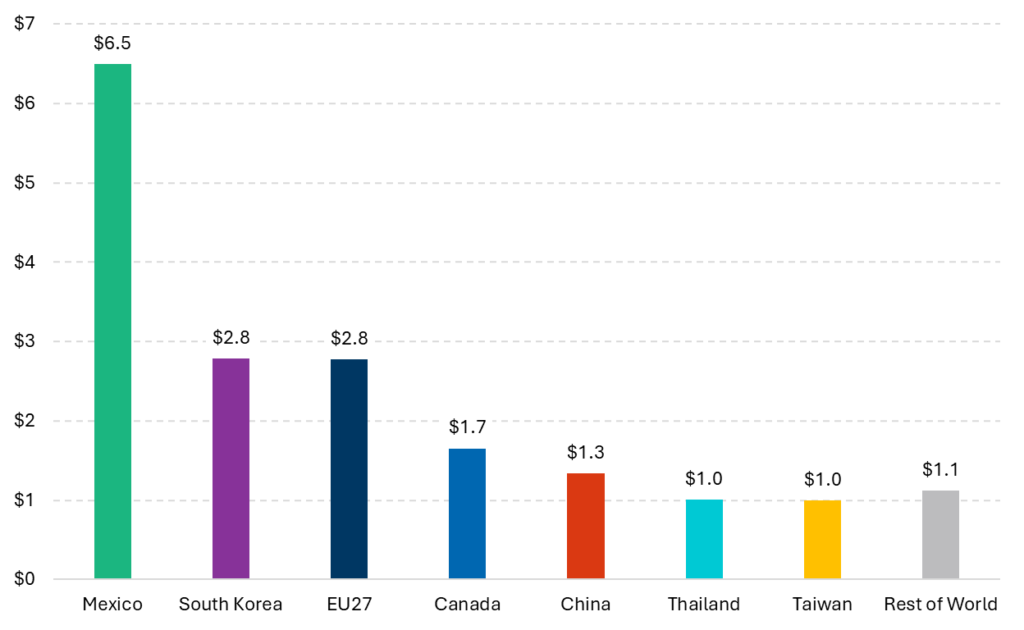
Chart 1: U.S. Transformer Imports by Trade Value, July 2025-2026 (USD billions)
Source: Global Trade Tracker; author’s calculations; HTS codes assessed include: 850421, 850422, 850423, 850431, 850432, 850433, 850434, covering both LPT and distribution transformers
Mexico is by far the largest source of U.S. transformer imports, accounting for 34% of import value. The U.S. absorbs roughly 95% of Mexico’s transformer exports, reflecting a highly integrated North American market. For large, difficult-to-transport equipment like transformers, that proximity provides an additional advantage to Mexican producers and American customers who can avoid the uncertainties, hazards, and delays associated with ocean-based shipping.
Many of our largest transformer suppliers have substantial domestic manufacturing bases.
Mexico has significant transformer manufacturing capacity, including major Prolec operations. South Korea is home to HD Hyundai Electric, Hyosung Heavy Industries, and other major producers; and the EU27 has significant manufacturing capacity, including Siemens Energy’s extensive European transformer operations.
Indirect Trade Exposure
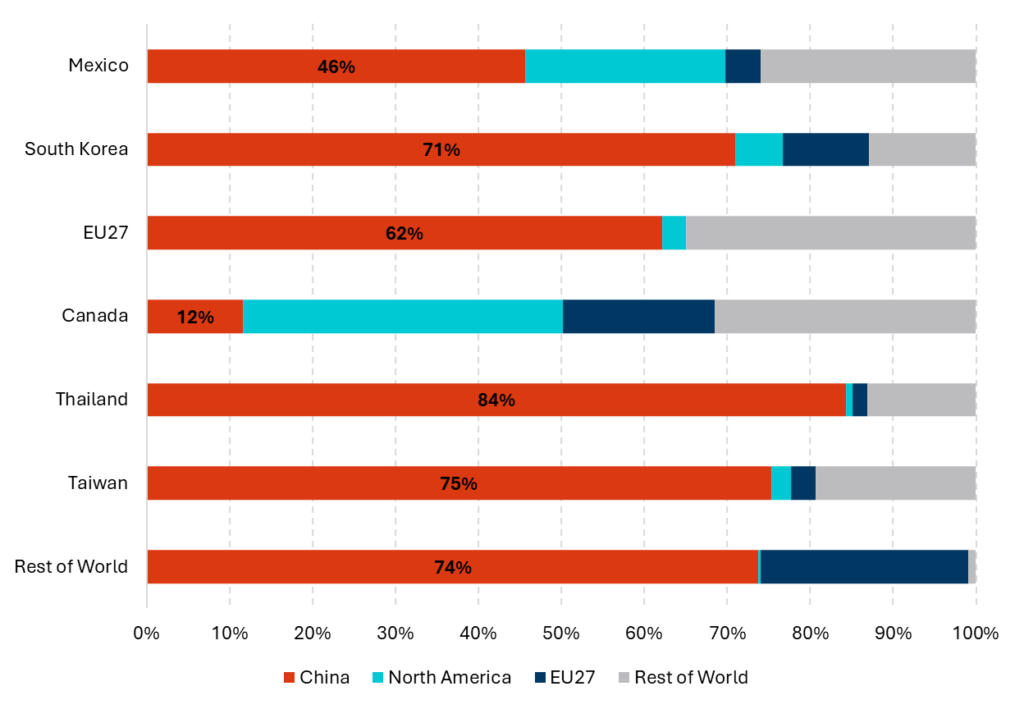
The global nature of transformer manufacturing can obscure vulnerabilities upstream of final assembly. To assess this “indirect” exposure, we need to understand which markets supply transformer inputs to our largest trading partners. The most significant inputs to transformer manufacturing are “transformer parts” and grain-oriented electrical steel (“GOES”), two goods categories with available bilateral trade data.
These indirect trade relationships point toward far greater vulnerability to disruption and geopolitical coercion than direct trade data alone would indicate. While China supplies just 7% of U.S. transformer imports, it is a high-leverage global supplier of transformer parts and GOES. The largest transformer suppliers to the U.S. rely on China for, on average, 60% of transformer parts and GOES imports.
Chart 2: Import share of transformer parts and GOES to largest transformer suppliers by region
Source: Global Trade Tracker; author’s calculations; HTS codes assessed: 850490, 722511, 722611
More than $10 billion in U.S. transformer imports—over half of the total—come from markets that import a majority of inputs from Chinese suppliers.
What Does This Mean for Grid Security Policy?
The U.S. will need more transformers, more quickly, to meet growing electricity demand. Building a secure supply chain will require looking beyond where finished transformers are manufactured to the origin of the inputs that support their production.
Policymakers should therefore pursue both expanded domestic manufacturing and greater diversification of upstream inputs among trusted partners. Otherwise, efforts to diversify transformer supply could leave significant underlying vulnerabilities intact.