The Trump administration has pulled back from formal American leadership on global decarbonization, withdrawing from the Paris Agreement and removing climate mitigation as a foreign policy priority. But it would be a mistake to write off the U.S. role in reducing global emissions, in both the near and long term. American economic statecraft tools—such as investment, financing, derisking, foreign assistance, and trade mechanisms—play a vital role in accelerating global decarbonization and supporting the development of the next generation of energy technologies.
This article outlines how deploying these tools to advance American competitiveness and counter adversarial influence can still yield significant near-term climate benefits, and why strengthening this toolkit today is essential to equipping future administrations to drive global decarbonization at scale.
Global Energy Trends and the Need for American Economic Statecraft
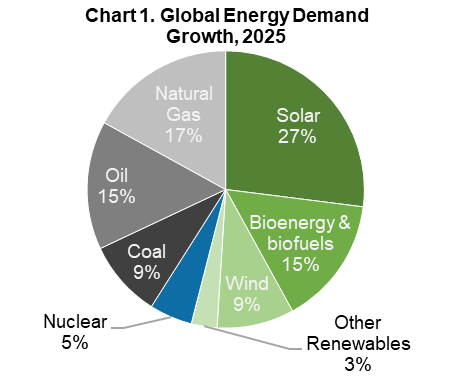
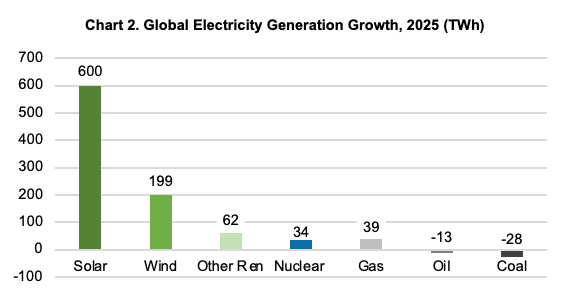
Over the past several years, clean energy deployment has exploded globally. In 2025, zero- or lower-carbon sources—solar, wind, biofuels, and nuclear—accounted for nearly 60% of the growth in global energy demand and nearly all new electricity generation (see Chart 1 & Chart 2).
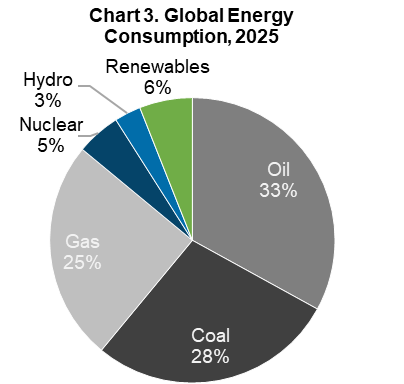
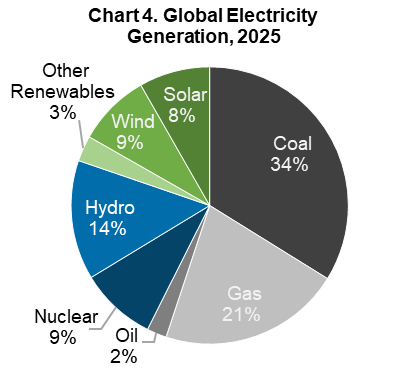
Despite these trends, fossil fuels without carbon mitigation controls like carbon capture and sequestration still account for the bulk of global energy consumption and electricity generation (see Chart 3 & Chart 4).
These clean energy deployment trends must accelerate to drive global change at the pace required, particularly in the energy-hungry emerging economies that are projected to drive most global emissions in the coming years. This is why American economic statecraft remains a vital element in advancing global decarbonization: it helps these economies develop faster and cleaner while advancing the next generation of technologies needed to complete the transition.
This administration’s focus on enhancing American competitiveness and countering Chinese influence can still support clean energy deployment and innovation, even if lowering global emissions is not a stated objective. And by strengthening America’s economic statecraft on a bipartisan basis today, policymakers can equip future administrations to drive global decarbonization at scale.
Economic Statecraft and Global Clean Energy Deployment
The U.S. has an array of economic statecraft tools to support developing countries as they grow and provide targeted support to their energy sectors. These include commercial diplomacy, economic and development assistance, technical assistance, project-preparation support, infrastructure support, and derisking and financing programs. They also extend to efforts to leverage multilateral forums and international financial institutions, and to mobilize private capital.
Through the effective use of these and other tools, the U.S. can cultivate the on-the-ground conditions that help energy investments succeed and unlock significant financing for new projects. While a future administration could direct these tools strictly toward decarbonization, deploying them today to counter adversaries like China can achieve near-term climate benefits.
Consider, the Trump administration has used development assistance programs to help American firms compete globally in key sectors like energy. In some cases, this means competing for clean energy projects. Iraq recently announced plans to add significant solar capacity to its grid, and a U.S. firm—UGT Renewables—signed a memorandum of understanding (MOU) to develop a 3 GW solar facility, with the Export-Import Bank (EXIM) of the U.S. as an intended financing source. Fossil fuel projects remain the larger share of these transactions—the Iraqi solar MOU should be understood in the context of much larger oil and gas transactions between Iraq and U.S. firms facilitated by administration officials. But the solar agreement shows that zero-carbon energy initiatives can exist within a larger energy framework. A future administration could use this foundation to greatly expand.
Economic Statecraft and Clean Energy Innovation
America’s role cannot be limited to enabling energy development abroad. It must also invest in innovating and deploying the next generation of clean energy technologies at home. Many existing technologies were pioneered in the United States but are now manufactured elsewhere. For example, the practical solar cell was invented at Bell Labs in 1954, but today, most solar panels are made in China. If the U.S. is to avoid repeating history with the next generation of technologies—like advanced nuclear, geothermal, and long-duration energy storage—it must be an innovator, manufacturer, and exporter, not an importer removed from global competition.
Among the best opportunities for the U.S. to lead in new technology market share are storage capacity and clean firm power. Although nearly all new electricity generation in 2025 was zero-emitting, most added power came from intermittent solar and wind. Global decarbonization will require massive storage and more stable power than what wind and solar alone can provide.
To build momentum for this next-generation clean energy leadership and sustain engagement across administrations, it is essential to tie into core domestic interests like boosting exports and creating jobs for American workers—and efforts are already well underway to develop these industries at home.
The U.S., already global leader in conventional geothermal, is poised to lead the development and trade of next-generation technologies thanks to its transferable oil and gas supply chains, technical capabilities, and expertise; the International Energy Agency estimates that over 75% of investments into next-generation geothermal are closely related to oil and gas industry skills and expertise. American firms are also leaders in advanced nuclear energy, such as small modular reactor (SMR) technologies, with at least 22 domestic designs in development, although they face competition from China and Russia. The administration has sought to quadruple American nuclear energy capacity by 2050, and the Department of Energy recently announced $17.5 billion in loans to rebuild America’s nuclear supply chain. Meanwhile, American firms are innovating a diverse set of long-duration solid-state batteries, competing with China and other nations to build diverse battery technologies to export globally. Just this month, the Department of Defense’s Office of Strategic Capital announced a $1.4 billion loan to support next generation anode and battery cell manufacturing in Washington State.
Studies show that expanded export markets support domestic innovation by increasing potential profits from R&D investment, especially in high-productivity, highly innovative firms. Economic statecraft tools can help by opening large global markets for these technologies and generating the demand that pulls American innovation to scale, crowding in private investment at home while hastening deployment abroad. This is already happening. In January, the Trump administration signed a credit agreement to finance site work for Poland’s first nuclear energy facility—a three-unit Westinghouse AP1000 plant. And in February, Vice President Vance announced completed civil nuclear cooperation negotiations with Armenia, where he stressed the export opportunities for U.S. nuclear firms, including up to $5 billion in initial exports.
Final thoughts
America’s economic statecraft toolkit can be a powerful instrument for economic growth and global decarbonization, but is too often under-authorized, under-resourced, and under-coordinated. Fixing this requires Congress to sharpen America’s economic statecraft tools through legislation like last year’s DFC reauthorization, the ongoing EXIM reauthorization process, and bipartisan legislation such as the DOMINANCE Act and the Pacific POWER Act. The administration, for its part, can drive significant administrative reform and, critically, improve interagency coordination. These efforts are not only worthwhile steps to improve American competitiveness and bolster American national security, but they are also vital to accelerating global decarbonization.