
The U.S. is a leader in the global energy trade, particularly for traditional energy exports like oil and gas. However, shifting market conditions and energy preferences are tipping the international market in favor of advanced energy technologies. China is the leading global exporter for these technologies, out-exporting the U.S. by over 9-to-1 to fast-growing, emerging economies.
To consider the implications for economic growth and opportunity, we analyze U.S. and Chinese energy export competition in India, which is forecast to be the largest source of energy demand growth in the world. The bulk of both India’s total energy supply and electricity generation comes from fossil fuels. However, India has set decarbonization and renewable energy goals and is on track to meet these goals early. Already, India has the fourth highest installed renewable energy capacity in the world, ranking third in solar and fourth in wind. In 2025, advanced energy capacity growth outpaced that of fossil fuels as electricity generation from coal fell 3%. The World Economic Forum predicts that India will have the fastest growth in renewable electricity capacity and generation globally; serving rapidly expanding energy needs in an emerging economy powerhouse represents a major opportunity for trade and investment.
This blog identifies trends in the exports of both traditional fossil fuels and advanced energy technologies—renewables (solar, wind, hydropower, geothermal, and biofuels), nuclear, battery storage and its supply chain, energy efficiency and grid technologies, and electric vehicles and their components—from the U.S. and China to India. As India’s pivot toward advanced energy sources continues to accelerate, data suggests that China, rather than the U.S., is poised to be India’s primary energy trade partner.
Comparing U.S. and Chinese Energy Exports to India
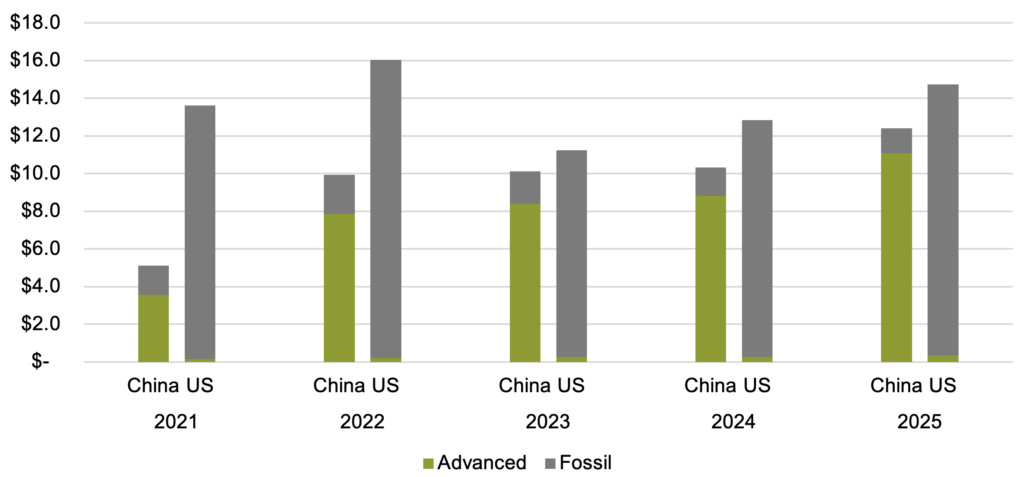
The U.S. has out-exported China across all energy exports over the last five years, almost entirely due to oil and natural gas (Chart 1). However, while the U.S.’s exports have remained relatively flat, China’s have grown substantially—more than doubling since 2021, due entirely to advanced energy exports.
Chart 1. U.S. and Chinese Energy Exports to India 2021-2025 (Billions USD)
Source: Global Trade Tracker, author calculations
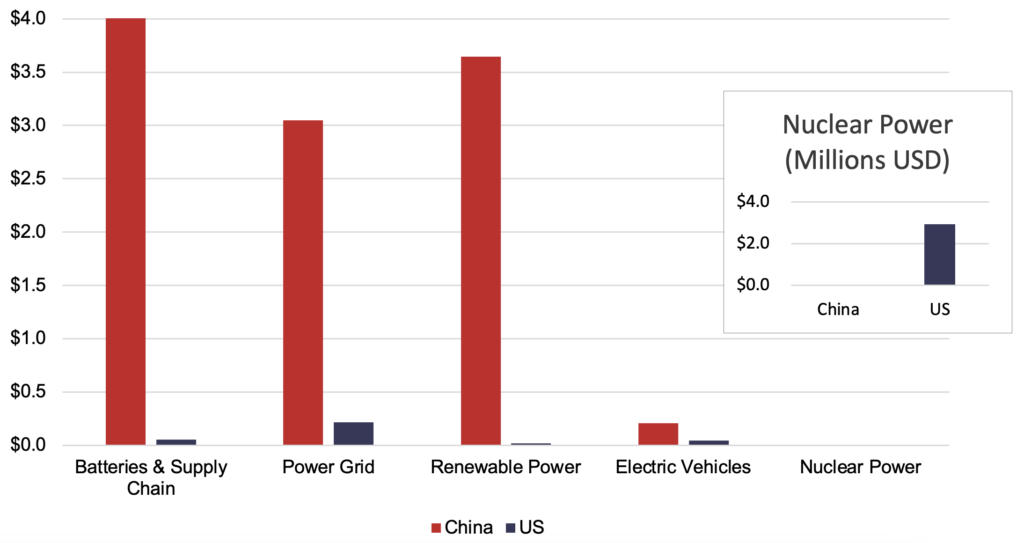
When looking at just advanced energy exports—the growth market for Indian energy demand—we see that China holds an assertive lead over the U.S. Since 2021, China’s advanced energy technology exports have more than tripled from $3.5 billion to over $11 billion while the U.S.’s exports remain at less than $350 million—around 3% those of China’s. In 2025, China’s advanced energy exports far surpassed those of the U.S. in almost every sector (Chart 2). As India trends toward advanced energy, this trajectory leaves the U.S. in a disadvantaged position as an energy exporter.
Chart 2. Advanced Energy Exports to India by Key Sector 2025 (Billion USD)
Source: Global Trade Tracker, author calculations
China’s exports to India are especially significant given the strained geopolitical relations between the two nations. India has refused to join the Belt and Road Initiative, and the two countries have been locked in a border standoff in the Himalayas since 2020. Despite these tensions, China remains the largest supplier of clean energy technology to India. The Indian firm Adani Green Energy is building the Khavda Renewable Energy Park, a 30-gigawatt hybrid solar-and-wind facility that will become the world’s largest renewable energy installation. Its primary solar panel supplier is the Chinese manufacturer JinkoSolar, which delivered 2.4 gigawatts of panels to the project—the largest single order in Indian solar history. Even as India looks to build a more robust domestic solar manufacturing base, it is building today’s energy transition on Chinese imports.
Opportunities for Growth
Analysis suggests that China is India’s trade partner of necessity rather than choice. U.S. firms can overcome China’s significant lead in advanced energy exports in several key areas. For example, while China has high nuclear export ambitions, it has not yet partnered with India, due in part to geopolitical tensions. American firms are innovating next generation advanced nuclear technologies that can be a good match for aggressive energy demand growth in India. In December, India passed the SHANTI Act, which significantly opens its nuclear sector to private and foreign investment. This legislation, combined with India’s ambition to increase nuclear capacity by over ten-fold in the coming decades, represents a significant opportunity for U.S. nuclear energy companies, some of which have been seeking to enter the Indian market for over a decade. India could likewise become a target trade partner for other forms of next-generation energy technology where American firms have a competitive edge over the Chinese market, like geothermal, or in areas where there has been significant U.S. manufacturing growth, like batteries.
Conclusion
As one of the fastest growing economies in the world and the projected largest source of energy demand growth globally, India will be the heart of energy trade competition. While the U.S. exports significant amounts of fossil fuels and equipment to India, recent trends signal the growing importance of advanced energy imports. China is leading this shift, significantly out-exporting the U.S. in advanced energy technologies to India and other emerging markets.
To continue strengthening American energy leadership and compete with China, the U.S. must diversify its energy exports, capitalize on its advantages in nuclear energy and other next-generation technologies, and, crucially, ensure that American businesses have the financing and trade policy tools to compete with China and others on a level playing field.