
The Export-Import Bank of the United States (EXIM) is up for reauthorization at the end of this year, and the data presents a compelling case for reforming the Bank. EXIM offers an array of financial services and tools, including insurance, loans, and guarantees, and is intended to elevate U.S. firms competing with state-backed rivals overseas. However, the private sector views EXIM’s tools as insufficient. In EXIM’s own annual survey of exporters and lenders, 64% of respondents rated EXIM as “far less competitive” or “slightly less competitive” than rival export credit agencies (ECAs).
The Council recently released its recommendations for reform to boost EXIM’s ability to support American firms competing with overseas state-backed companies. To lend additional context to our priorities for reauthorization, this blog examines how EXIM has fared against rival ECAs over the past decade. The data reveals a wide and growing competitiveness gap. Reauthorization therefore presents a critical opportunity to ensure the Bank is an effective tool for American businesses and workers.
Categories of Financial Assistance
Generally, ECAs provide two broad categories of support. The first is export credit—including short-, medium-, and long-term loans, guarantees, and insurance commitments tied directly to an export sale. Larger, more complex transactions—such as major infrastructure projects with significant implications for trade relationships, supply chains, and geopolitical influence—typically require medium- and long-term (MLT) export credit support. This makes MLT activity a useful marker of an ECAs’ competitiveness, and EXIM’s own Competitiveness Report is built around MLT export credit as its benchmark.
The second category is trade-related financing—such as investment support (financing for strategic outbound investment) and untied aid (assistance that is not directly linked to an export). Unlike many other ECAs, EXIM does not offer investment support or untied aid; in the U.S. system, those tools sit at other agencies, such as the Department of State, the U.S. International Development Finance Corporation, and the U.S. Trade and Development Agency.
EXIM has fallen behind rival ECAs
Every year, EXIM submits to Congress its annual Competitiveness Report, which entails a survey of stakeholders as well as a survey of worldwide official MLT export credit provided that year. EXIM’s 2024 Competitiveness Report reveals that EXIM lags behind its ECA competitors in two key ways.
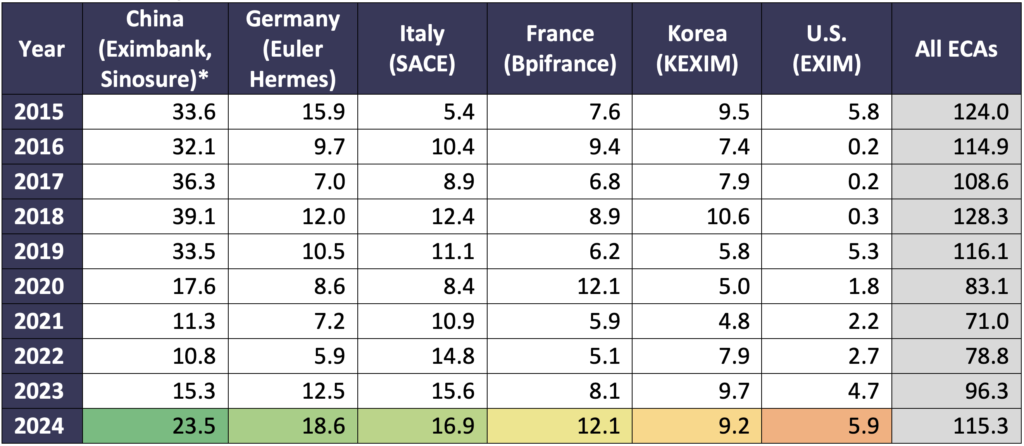
First, EXIM mobilizes much smaller levels of MLT export credit than many other ECAs. In 2024, France and Italy more than doubled EXIM’s activity, while China and Germany more than tripled it (Chart 1).
Chart 1. MLT Export Credit Volumes (Billions USD)
Source: EXIM 2024 Competitiveness Report
*China’s figures are estimated by EXIM and may be higher than reported.
Second, EXIM has failed to keep pace with growth at other ECAs, especially post-pandemic. Global MLT export credit volumes peaked in 2018 and nose-dived during the 2020 Covid pandemic. Since then, many other ECAs have not only recovered to but surpassed pre-pandemic levels of MLT activity. France nearly doubled its pre-pandemic export credit activity, from $6.2 billion in 2019 to $12.1 billion in 2024, while Germany, Italy, and Korea each grew their MLT activity by more than 50% over the same period.
There are two exceptions to this trend. The first is China’s MLT figures sit at just over two-thirds of its pre-Covid activity levels; despite this decline, China retains a world-leading $23.5 billion of MLT export credit activity—20% of all ECAs’ MLT activity.
The second exception is EXIM. While it recovered from its 2020 low of $1.8 billion (not including 2016-2018, during which EXIM’s board lacked a quorum to approve major transactions), its 2024 volume of $5.9 billion is only $0.6 billion above pre-covid levels. EXIM’s stagnation inhibits it from adequately supporting U.S. firms.
Factoring in GDP accentuates the gap
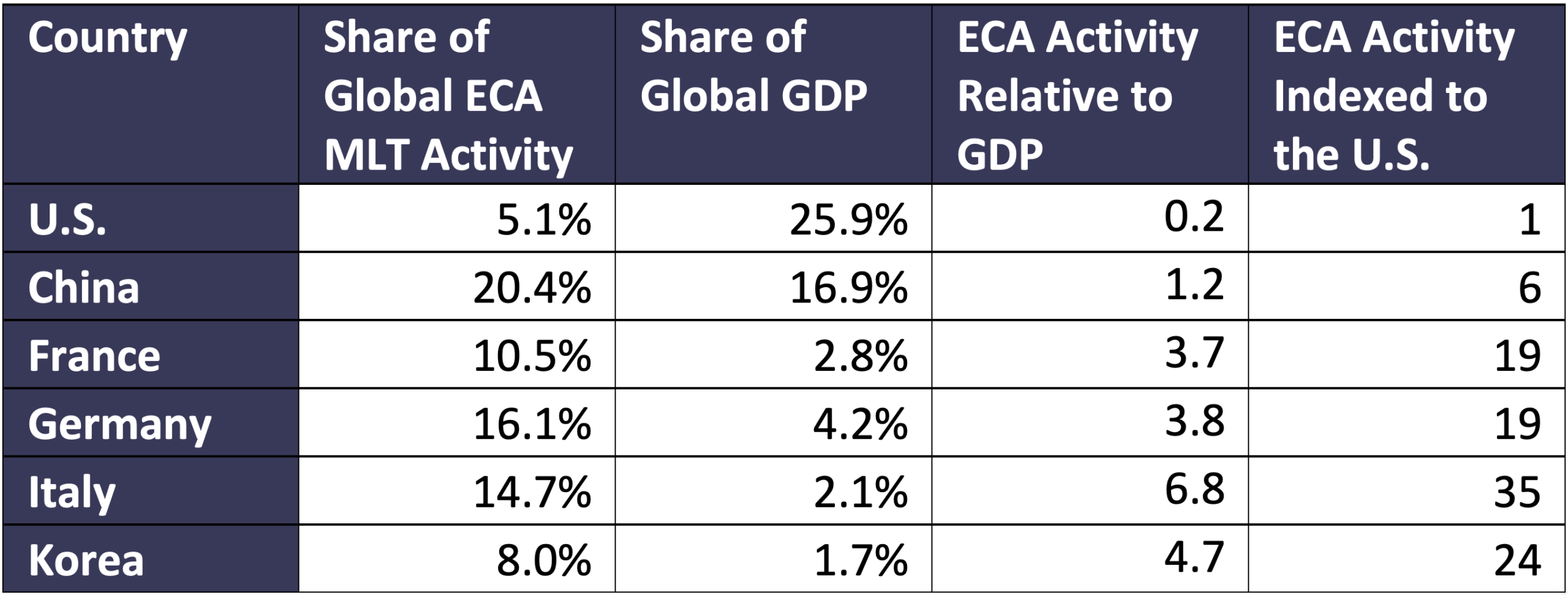
The competitiveness gap between EXIM and foreign ECAs becomes even more stark when factoring in the size of host countries’ economies. Despite the United States accounting for nearly 26% of global GDP, EXIM’s export credit only makes up around 5% of global ECA MLT activity. By contrast, France, Germany, Italy, and Korea all punch above their economic weight, running ECAs whose share of global credit activity exceeds their share of global GDP (Chart 2). Indeed, among countries with major ECAs, the U.S. is the only one whose share of ECA activity falls below its share of global GDP—and by a wide margin.
Chart 2. Share of Global GDP and ECA MLT Activity 2024
Source: EXIM 2024 Competitiveness Report, World Bank
To further explore this disparity, this blog creates an ECA Activity Index that examines the intensity of each country’s ECA compared to EXIM. The index calculates each country’s ECA MLT activity as a share of its global GDP, measuring how much export credit an ECA deploys relative to the size of its country’s economy. That ratio is then benchmarked against the United States. On this measure, France and Germany’s ECAs are 19 times more active than EXIM relative to their economic size, while Korea’s and Italy’s are 24 and 35 times more active, respectively. Even China, which also accounts for a significant share of global GDP, still operates its ECAs at six times U.S. activity.
Comparing EXIM’s MLT credit activity to that of other ECAs—especially when factoring in the United States’ share of global GDP—reveals a persistent failure to provide sufficient support for American businesses competing overseas. Reauthorization presents a critical opportunity for Congress to reform the Bank and support American firms competing in global markets that are increasingly shaped by state-backed competition. Read the Council’s recommendations, Unlocking EXIM: Priorities for Reform, to learn more.