
Guest Blog: This piece was contributed by Dr. Jane Flegal, who is a Senior Fellow at the Searchlight Institute and The States Forum. Jane also supports the Council’s work as a Policy Advisor on electricity infrastructure issues.
Electricity affordability is a genuine, urgent concern for many American households and businesses. In nominal terms (not adjusted for inflation), residential electricity bills rose roughly 27 percent from 2019 to 2024, and equipment costs have soared: transformer prices are up 89 percent since 2019 and wire and cable is up 152 percent.
Elected officials are right to take these concerns seriously, particularly for low-income households. Developing a policy agenda that addresses the problem requires clarity about what we can and must solve. In truth, electricity prices are likely to continue rising in the short term. This is a consequence of policy choices we have already made and grid investments we didn’t make.
An honest conversation would not center on false promises about reducing near-term electricity bills; it would focus on building a grid capable of delivering long-term affordability.
Structural Reasons Electricity Prices Are Not Coming Down
Several structural forces are driving prices upward, and none can be solved with short-term interventions.
1. Demand for electricity is increasing.
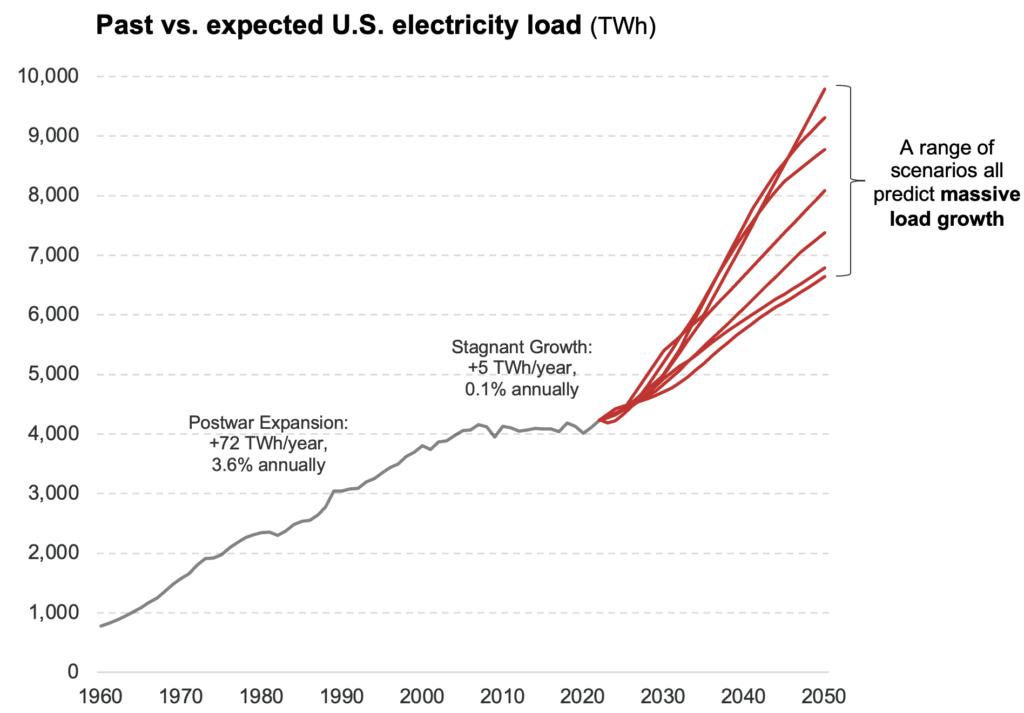
After decades of flat electricity demand growth, during which efficiency gains offset economic and population growth, the U.S. Energy Information Administration (EIA) now forecasts U.S. electricity consumption will surpass an all-time high in 2026 and again in 2027.
Data centers are an important driver, with demand from these facilities tripling over the last decade. The IEA and Rhodium both project that data centers will account for roughly 50% of all U.S. electricity demand growth in 2030.
But manufacturing and electrification are also likely to increase demand over the long term: EPRI projects that EV load overtakes data center load around 2035 under medium growth assumptions, with total electrification demand substantially larger beyond that horizon (although distribution across states varies significantly). The point is that the electrification of the U.S. economy—the shift from burning fossil fuels in cars, homes, and factories to powering them with electricity—coupled with economic growth was always going to require a larger grid.
Rising electricity demand is good news on balance, but it requires investment.
2. The grid needs major capital investment, and that costs money.
Most of the transmission and distribution infrastructure that exists today was built more than half a century ago and is approaching or already past the end of its life cycle.
Replacing and expanding infrastructure is expensive, and those costs flow through to ratepayers—households, businesses, and industrial facilities. While concerns about unnecessary spending by utilities (particularly on local transmission and distribution) are real, most of this spending is not optional. Delaying necessary investment threatens the reliability of our electricity system and risks more expensive fixes when it fails.
3. Limiting exposure to fuel price volatility requires investment and time.
Natural gas sets the marginal price—the price for the last unit of electricity needed to meet demand—in most of the country during most hours. That leaves electricity prices vulnerable to gas price swings.
This volatility tends to be driven by changes in domestic demand, including weather-driven events, and infrastructure constraints. Reducing exposure to fuel volatility requires investment in two things: natural gas infrastructure in regions where pipeline bottlenecks amplify price spikes, and zero-fuel-cost technologies (i.e., solar, storage, geothermal) so that natural gas sets the price less often. In either case, building these projects costs capital, which means higher prices in the near term before fuel cost savings materialize.
4. Physical threats present permanent, growing costs.
Climate change is making extreme weather more frequent and severe, and population growth is expanding into vulnerable areas. As a result, the grid is being damaged more often.
Grid hardening to upgrade physical infrastructure requires proactive investment, with the cost ultimately falling on ratepayers. This is showing up in bills today: LBNL found that in California, wildfire mitigation costs added 4 cents per kWh from 2019-2024. Hardening the grid proactively costs less than rebuilding after a disaster, but it still requires near-term spending.
The uncomfortable truth is that electricity prices are going up. Any honest discussion of affordability must start from this premise. The real choice is whether we use this moment to build a grid that delivers affordable, reliable electricity down the line… or starve the grid of investment and face ever-larger rate spikes and reliability threats.
Limits of the Near-Term Affordability Frame
The near-term affordability frame could backfire in several ways. Most importantly, it’s focused on resisting something we should want: growing electricity demand, which reflects economic activity. Slow interconnection will delay economic activity and push it off the grid, leaving remaining ratepayers to shoulder the rising fixed costs of hardening and modernizing the system.
Large loads like data centers can pay a premium to get power without connecting to the grid. Manufacturers can build facilities wherever it’s easier to access reliable power. In short, policies that prioritize near-term affordability over long-term affordability risk pushing industry—and their ability to pay for infrastructure improvements—off the shared grid.
Three policies already trading long-term grid improvement for short-term relief:
Rate Freezes
Rate freezes provide immediate relief but starve utilities of the revenue needed to modernize the grid, borrowing against future reliability and affordability to score political points today.
The Brattle Group and LBNL have both documented that suppressing utility investment during periods of growing demand reliably produces rate spikes that dwarf what the original investment would have cost. A freeze that holds bills flat for two years can produce a decade of elevated rates and a less reliable grid. Low-income households bear the brunt of this harm. They’re the most exposed to extreme weather and the least able to absorb the reliability failures and rate spikes that follow from underinvestment.
Behind-the-meter (BTM) gas
Behind-the-meter (BTM) gas takes pressure off the grid in the short run (and in some instances provides faster, though less reliable, access to power) but delivers none of the grid benefits of shared generation.
BTM plants tend to be much less efficient than grid-connected gas facilities, and some load centers have also opted for unconventional, even less efficient solutions like jet engines. This approach privatizes the solution and robs the electricity system of the capital and political will that could finance the shared infrastructure we need to achieve multiple national goals.
Blocking regional cost-sharing for new transmission
Blocking regional cost-sharing for new transmission, the notion that ratepayers in one state should not subsidize power lines that benefit another, may seem reasonable in the context of the data center buildout, especially when framed as protecting ratepayers. But it misunderstands how transmission works.
Transmission lines inherently create benefits that spread across a whole region, not just where they are built. Strict cost-causation rules could make it harder to build shared infrastructure—and harder for states to implement ambitious clean energy policies, since those often depend on transmission that’s planned and paid for regionally.
The political implications:
While the economic and emissions costs of approaching today’s crisis through the narrow lens of near-term affordability are serious, there are also political costs. Namely, it forecloses reforms that matter at the exact moment when those reforms are within reach. The structural reforms needed to deliver affordable and reliable electricity—federal transmission planning, permitting reform, clear rules of the road on cost allocation—require a powerful political coalition.
We are closer than ever to building this coalition, in part because of rising data center electricity demand:
- Manufacturing state policymakers want the industrial load that a modern grid enables.
- National security-oriented policymakers understand grid resilience as a security imperative.
- Officials in states with significant data center buildout are under active pressure to fix grid policy.
The affordability-first frame not only risks failing to advance the agenda, but it also risks fragmenting the coalition needed to pass it—pitting existing ratepayers against load growth and framing new electricity demand as a threat rather than an opportunity. A frame organized around abundance and competitiveness can hold this coalition together and advance the right agenda at the right time.
What Affordability Actually Requires
The grid is aging, demand is growing, and extreme weather is accelerating. These forces will continue placing upward pressure on costs. The political promise embedded in the near-term affordability frame—that resisting investment will protect consumers from rate increases—is a promise that cannot be kept.
The honest version of the affordability solution is to invest more and share costs fairly.
Relief for households and communities facing high electricity rates should not come at the cost of building the infrastructure our economy and security depend upon. The way to protect those ratepayers is not to freeze bills while the grid deteriorates, but to invest in transmission that spreads fixed costs over a larger base, design cost allocation and other frameworks that leverage industry’s willingness to pay, and expand access to clean energy resources that reduce fuel cost exposure.
The fundamental choice facing the U.S. today is not between household affordability concerns and industry-driven investment. The question is whether we will build the platform capable of delivering cheap, reliable electricity to everyone and fix the processes that let the backlog in grid modernization, hardening, and expansion accumulate in the first place. Those are hard questions, but they are the right ones. A country that answers them well ultimately gets abundant, affordable electricity. A country that avoids them will get neither.
Key References
Bakke, Gretchen. The Grid: The Fraying Wires Between Americans and Our Energy Future. New York: Bloomsbury USA, 2016.
The Brattle Group. “New Brattle Report Finds Better Utilization of Existing Power Grid Could Save U.S. Consumers More Than $100 Billion in the Next Decade.” 2026.
David, Paul A. “The Dynamo and the Computer: An Historical Perspective on the Modern Productivity Paradox.” American Economic Review 80, no. 2 (1990).
Huber, Matt, Fred Stafford, and Leigh Phillips. “The Left Has Always Fought for Abundance.” Catalyst, 2025.
International Energy Agency. Electricity Grids and Secure Energy Transitions. Paris: International Energy Agency, 2023.
Lawrence Berkeley National Laboratory. Retail Electricity Price Trends and Drivers: Data Update—2026 Edition. Berkeley, CA: Lawrence Berkeley National Laboratory, 2026.
Lipsey, Richard G., Kenneth I. Carlaw, and Clifford T. Bekar. Economic Transformations: General Purpose Technologies and Long-Term Economic Growth. Oxford: Oxford University Press, 2005.
National Center for Energy Analytics. Electrification Without Electricity: An Epic Failure in Planning for Critical Infrastructure. January 2025.
Nye, David E. Electrifying America: Social Meanings of a New Technology. Cambridge, MA: MIT Press, 1990.
Walters, Daniel E. “Lumpy Social Goods in Energy Decarbonization: Why We Need More Than Just Markets for the Clean Energy Transition.” University of Colorado Law Review 93 (2022): 541–611.