The Trump administration has made international partnerships a central pillar of its efforts to secure U.S. critical mineral supply chains and has announced a variety of novel nonbinding partnerships and plurilateral initiatives such as Pax Silica and the Forum on Resource Geostrategic Engagement (FORGE). Together, these efforts may provide the foundation for a legally binding Agreement on Trade in Critical Minerals (ATCM), currently under consideration by the Office of the United States Trade Representative (USTR).
In support of critical mineral partnerships through the lens of trade, the Council has developed frameworks for ATCM design, African Growth and Opportunity Act (AGOA) modernization, and United States-Mexico-Canada Agreement (USMCA) review. We also published a menu of policy instruments spanning transparency, market stabilization, trade protection, and investment.
This analysis builds on prior work by identifying which partner country attributes would allow an ATCM to address vulnerabilities across the full supply chain for the 13 critical mineral categories[1] essential to advanced energy technologies.
A strong and complementary ATCM must include partners that address three distinct vulnerabilities that the Chinese Communist Party (CCP) exploits to destabilize mineral supply chains.
| Source of CCP Market Leverage | Strategic Characteristics of ATCM Partners |
|---|---|
| Market control in upstream[2] and midstream[3] processing capacity | Producer economies with abundant natural or industrial resources |
| Monopsony power in purchasing minerals and midstream products | Consumer economies that can scale demand for alternative mineral resources |
| State-backed market distortions that deter investment | Investor economies capable of sustaining large capital investments |
Chart 1: Market Characteristics of ATCM Partners and Country Examples
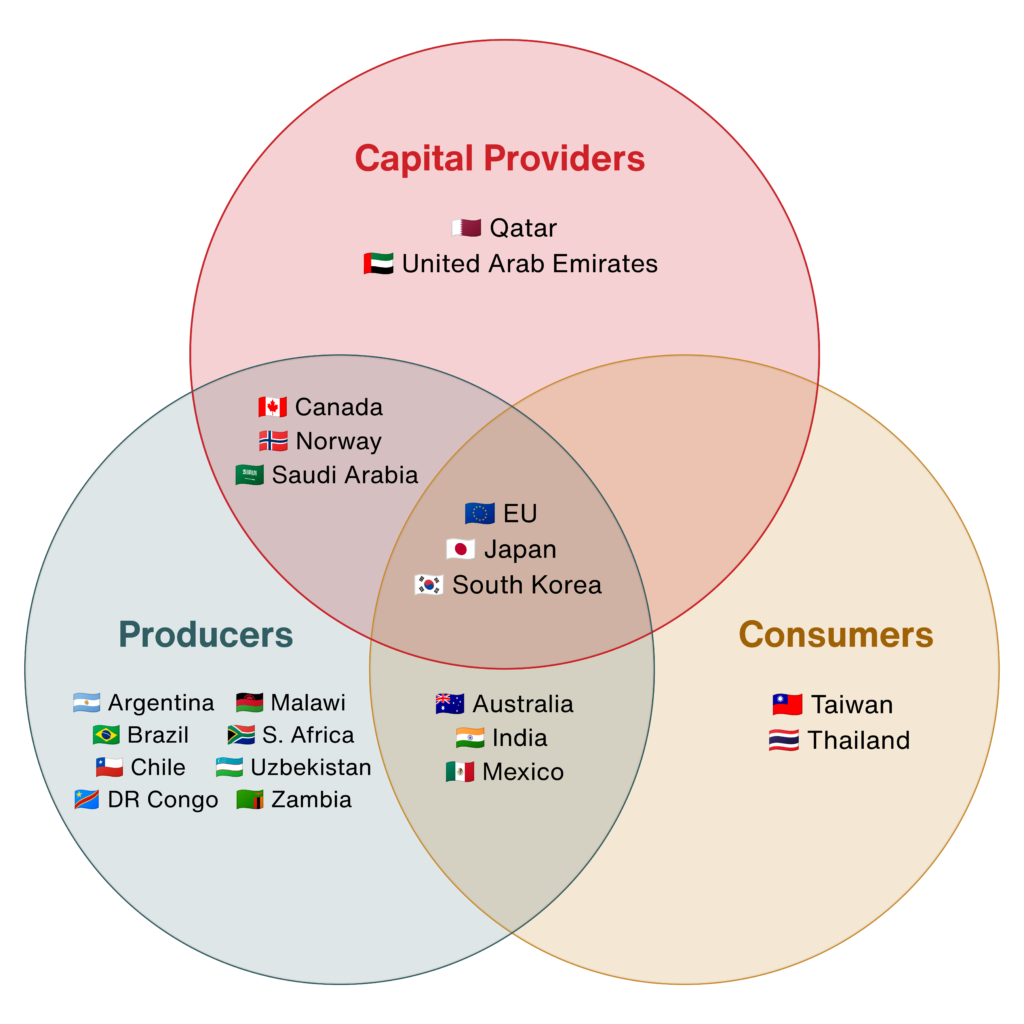
Where countries appear across multiple categories, they carry compounded strategic value.
Category 1: Producer economies with abundant natural or industrial resources
Concentrated supply chains leave U.S. firms and those of its partners vulnerable to export restrictions, geopolitical tensions, natural disasters, and other shocks. The CCP controls significant shares of mining for a subset of minerals such as graphite and rare earth elements and dominates midstream processing across a broad range of minerals.
An ATCM can reduce this dependence by bringing together producer economies capable of expanding and diversifying upstream extraction and midstream processing activities—including chemical processing, refining, smelting, recovery, and recycling. These partners would provide reliable alternatives to CCP-controlled supply chains and bring additional supply to global markets as demand for critical minerals from advanced energy technologies alone is projected to nearly double by 2040.
Promising producer partners (examples):
- Partners with mining, processing, and infrastructure: Australia, Canada, South Africa, and Saudi Arabia each have significant mining sectors, processing capacity, and strong infrastructure across a range of minerals including lithium, copper, nickel, manganese, and rare earth elements. Their established mineral industries and infrastructure may offer an ATCM reliable production capacity, bankable investment prospects, and secure sources of supply.
- Partners with mining capacity and ample reserves: Chile, Argentina, Brazil, Zambia, and the Democratic Republic of the Congo hold substantial production and reserves of key minerals—including lithium, copper, cobalt, graphite, and rare earth elements—offering alternative supply and future resource potential.
- Partners with processing, recycling, and recovery capabilities: Norway, Japan, South Korea, and EU member states have established midstream industrial capacity across mineral refining, chemical processing, smelting, recycling, and recovery.
- Partners with emerging production potential: India, Malawi, and Uzbekistan have proven resources and nascent minerals industries. Partnership with these economies early in their industrial development can prevent the CCP from subsuming these resources into their supply chains. In 2025, Chinese firms invested a record $32.6 billion in the global metals and mining sector, underscoring the pace of China’s expansion.
Together, these producer partners can expand access to mineral resources, increase industrial capacity, and reduce exposure to supply disruptions. Developing and sustaining this diversified supply base, however, requires clear and durable demand from consumer economies.
Category 2: Consumer economies that can scale demand for alternative mineral resources
China is the largest purchaser of many mineral ores and concentrates, giving the CCP near-monopsony influence over global prices, trade flows, and competing producers. It reinforces this leverage through industrial policies that keep mineral inputs—and the downstream value chains that depend on them—within mainland China.
An ATCM can counter this influence with the purchasing power of large industrial and manufacturing bases in consumer economies. Their demand for processed minerals and manufactured components, particularly for advanced energy technologies, can create reliable markets for the non-CCP supplies brought online by producer country partners.
A particularly potent approach to harnessing this collective market power is through market-access rules—including sourcing requirements, traceability standards, rules of origin, and Foreign Entity of Concern (FEOC)-equivalent restrictions—that prioritize trusted suppliers. Other coordinated policy mechanisms can further reinforce market access rules, like preferential treatment for member-country producers and coordinated procurement preferences, advanced market commitments, offtake agreements, and other incentives for intra-member trade. Together, these measures can counter CCP-driven market distortions and provide the commercial certainty needed to support long-term investment in alternative mineral resources.
Promising consumer partners (examples):
- Partners with large manufacturing demand and compatible policy frameworks: Japan, the European Union, South Korea, and Mexico each have substantial manufacturing demand across electric vehicles, lithium-ion batteries, wind turbines, semiconductors, and other advanced technologies. They have also entered into critical minerals action plans or frameworks with the U.S. and so are already exploring how coordinated trade policies and other market-based measures can counter non-market practices, reduce supply chain vulnerabilities, and support diversified critical mineral production.
- Additional manufacturing hubs: Taiwan, India, and Thailand are important centers for semiconductors, electronics, battery components, electric vehicles, and other advanced technologies. Partners not yet in critical mineral agreements with the U.S. could further broaden the ATCM’s demand base for critical mineral inputs.
Together, these consumer partners can create the scale, durable demand, and commercial certainty needed to sustain alternative supply chains. Demand alone, however, may not overcome the high capital requirements and market risks facing new mining and processing projects. An ATCM must therefore also include investor economies capable of mobilizing long-term capital.
Category 3: Investor economies capable of sustaining large capital investments
The IEA estimates that approximately $500 billion in new mining investment will be needed by 2040, even before accounting for the processing capacity and supporting infrastructure required to bring those resources to market. Resilient supply chains require diversified production and sufficient demand, as well as deep capital resources capable of supporting enormous new development.
Two factors compound the challenge. First, the CCP discourages competition in critical mineral markets and downstream industries by manipulating prices and supply in ways that undermine investment in alternative projects. Second, processing projects outside of China can face dramatically higher capital and operating costs, making these projects extremely vulnerable to market manipulation.
Investor economies are therefore indispensable ATCM partners that can help members withstand market distortions and scale supply. Their public finance institutions, sovereign wealth funds, and private investors can offer loan guarantees, insurance, co-investment, and patient capital needed to absorb early-stage risks and sustain projects through periods of artificial price suppression. Public finance institutions absorb a portion of project risk, attracting the large scale of private capital necessary to sustain investment in reliable, alternative, growing supplies.
An ATCM can spread risk across investor economies and identify priority investments. Investor economies may agree to coordinate financing programs, align investment priorities, develop shared project pipelines, and combine complementary financial instruments. For example, public guarantees and political-risk insurance can improve project bankability, while equity investments, long-term debt, and sovereign capital can finance construction and expansion across mining, processing, recycling, and supporting infrastructure.
Promising investor partners (examples):
Partners with substantial public and sovereign financing capacity: The EU member states, Japan, South Korea, Saudi Arabia, the United Arab Emirates, and Qatar have large and active international investment, export credit, and sovereign wealth programs. Institutions such as the European Investment Bank and Japan Bank for International Cooperation can reduce project risk through loans, guarantees, and co-investment, while Gulf sovereign wealth funds can provide large capital resources aligned with government priorities. Coordination across these programs can attract large additional investments from commercial banks and institutional investors.
Together, these investor partners can mobilize financing at the scale needed to build diversified mining, processing, recycling, and supporting infrastructure. By reducing risk and improving expected returns, an ATCM can unlock private capital at the scale needed to build diversified supply chains while helping projects withstand CCP-driven market distortions.
Conclusion
An ATCM presents a significant opportunity to build more resilient critical mineral supply chains with international partners. By bringing together a diverse coalition that includes producer, consumer, and investor economies—with representation spanning the full basket of critical minerals relevant to advanced energy technologies—the agreement can counter CCP market influence while providing the supply, demand, and capital needed to scale alternative supply chains supporting the growing demand.
[1] Critical Minerals as defined by the Energy Security Act of 2020 and identified in the 2026 USGS critical mineral list.
[2] Upstream activities include mining and beneficiation, producing unprocessed ores and mineral concentrates.
[3] Midstream activities include chemical processing, smelting, refining, recycling, and recovery, which convert mined or recovered materials into refined minerals and other usable industrial inputs.