
In less than eight months, the United Kingdom’s Carbon Border Adjustment Mechanism (CBAM) goes into effect. A key design choice threatens to undermine the environmental integrity of the policy, induce more carbon leakage, and disadvantage cleaner firms—including U.S. manufacturers. More concerning, it would set bad precedent as other countries around the world develop their own border adjustment approaches.
The threat: the UK’s process for establishing the emissions intensity of imported products. There are two approaches to determining the emissions intensity of imported products under a CBAM: verified, facility-specific “actual data,” and administratively determined default values that estimate the emissions intensity of a good. Most border adjustment policies use some combination of the two.
The UK CBAM will permit the use of actual data, though the government has not yet published final rules for how an importer may establish their emissions intensity. Global manufacturers are already producing goods that will eventually be priced by the UK CBAM—and they don’t know what emissions they must document or how to report them. Providing actual data in the first year of the CBAM may not be possible without clear and early guidance.
For goods imported without actual data, the UK will assign a default based on the average emissions intensity of UK imports, a “global average embodied emissions weighted by production volumes of key UK trading partners.” The UK government concluded it was “infeasible” to develop more specific country-specific defaults before the CBAM becomes operational next January but will revisit the question after 2027.
Especially in the first year of the program, it is likely that even the most efficient firms will be assigned inaccurate, high default values. The consequences of that choice are significant. Emissions intensities for the same product can vary enormously depending on the production process. U.S. manufacturers produce many key industrial goods at emissions intensities well below the global average, while producers in several other major exporting countries operate well above it.
The disparity is not abstract. UK Steel estimates that use of global default values could allow the highest emissions Chinese steel to be imported into the UK with an effective 86% discount of the CBAM price that would be due based on actual emissions data. A single global default obscures differences in the emissions intensity of manufacturing entirely.
The data below, pulled from the Council’s carbon advantage literature and UK trade data, estimates the average UK import intensity of basic metals. The UK’s three largest trading partners by value are the EU countries, India, and Korea. While the EU has a similar emissions intensity to the UK and the U.S., Korea and India are much more emissions-intensive producers of basic metals. Their presence in the import mix drives up the average emissions intensity of imports.
Table 1. Emissions intensity of basic metals production, UK and major trading partners
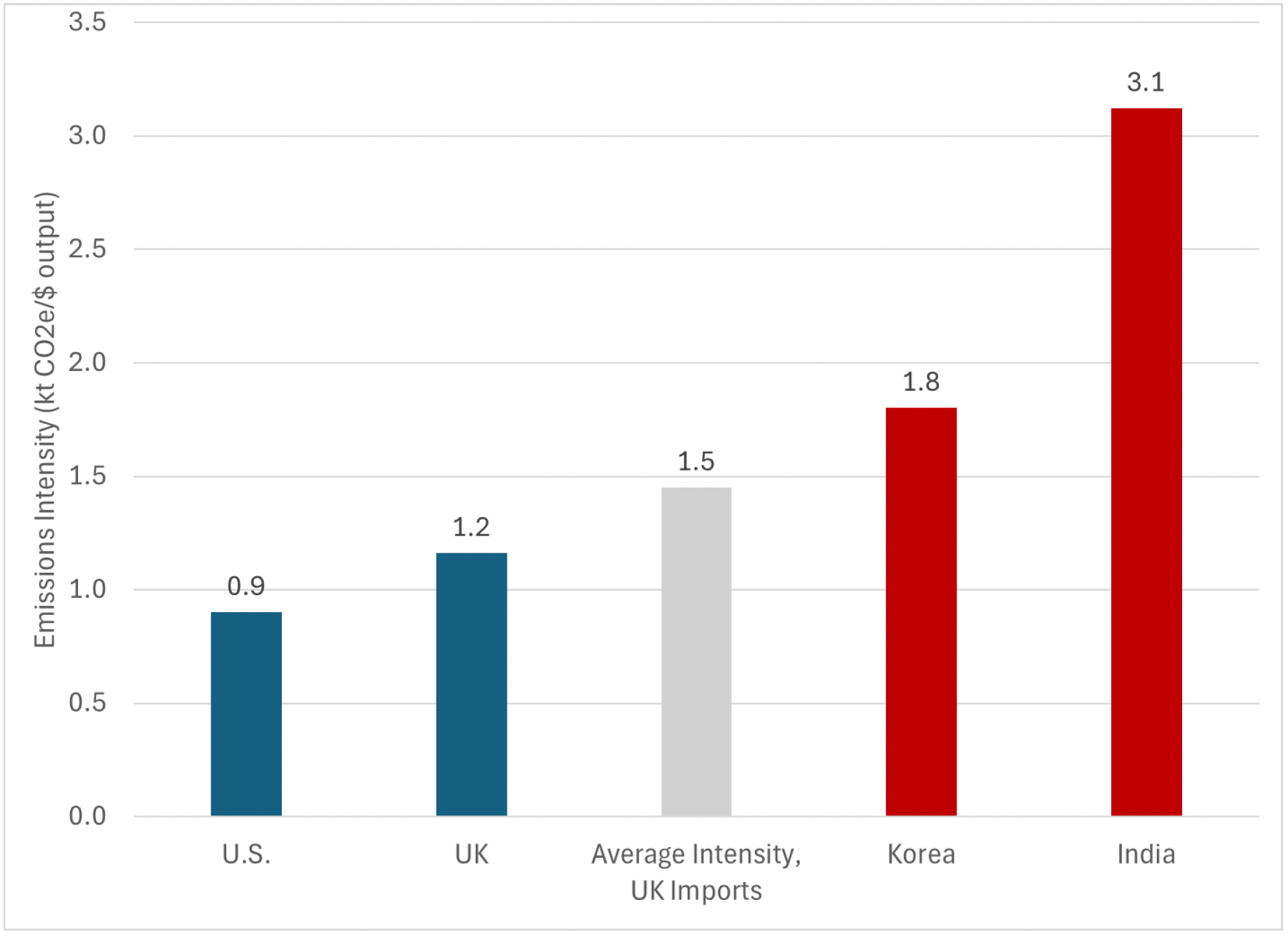
More efficient producers will be at a disadvantage. Under the UK Emissions Trading Scheme (ETS), UK manufacturers will be charged based on their full actual emissions. Imports from the U.S. would be assigned an emissions intensity and pay a CBAM charge well above what their environmental performance would indicate. Less efficient firms will be able to avoid paying for pollution control and will reap the benefit of paying a lower price for entry into the UK market.
Global defaults undermine the CBAM’s central purpose. By giving high-emissions manufacturers a competitive advantage, global defaults invite the very leakage the policy is meant to prevent and weaken the UK ETS’s effectiveness in reducing net emissions.
The UK government is accepting comments on its draft regulations implementing the CBAM until May 21, which provides stakeholders with an opportunity to propose alternatives to global default values.
Country-specific default values that reflect actual emissions intensity of production would be fairer, more accurate, and much more effective in addressing leakage than use of global averages. They would also lay the groundwork for interoperable CBAM regimes worldwide. The EU took the positive step of producing country-specific defaults under its CBAM. As the Council has highlighted, however, some of those defaults are based on the most emissions-intensive methods of production, rather than average emissions intensity. Just like global defaults, this approach unfairly penalizes more efficient manufacturers and undermines the environmental goals of the policy. The UK should develop country-specific defaults that accurately reflect the average emissions intensity of producers, including more efficient U.S. firms.
More countries, including Taiwan, Norway, Australia, and Canada, are developing CBAMs and will make judgements about setting defaults that will impact U.S. producers. The UK has an opportunity to set a higher, fairer standard from the outset; global defaults would start the program out on the wrong foot.